Brady B-427 vs. B-342 Comparison
Post-Termination Self-Laminating Wrap vs. Pre-Termination Full-Circumference Heat-Shrink Sleeve. This in-depth technical analysis provides side-by-side engineering data, ASTM laboratory adhesion scores, operating temperature thresholds, chemical immersion resistance, and Total Cost of Ownership (TCO) models.
Choose B-427 for retrofitting already-terminated cables (Cat6, patch cords, control wiring) without disassembling connectors. Choose B-342 for mission-critical aerospace, military harnesses, and high-heat environments (-55°C to 135°C, SAE AS-81531) where sleeves can be slid onto bare wires prior to lug crimping.
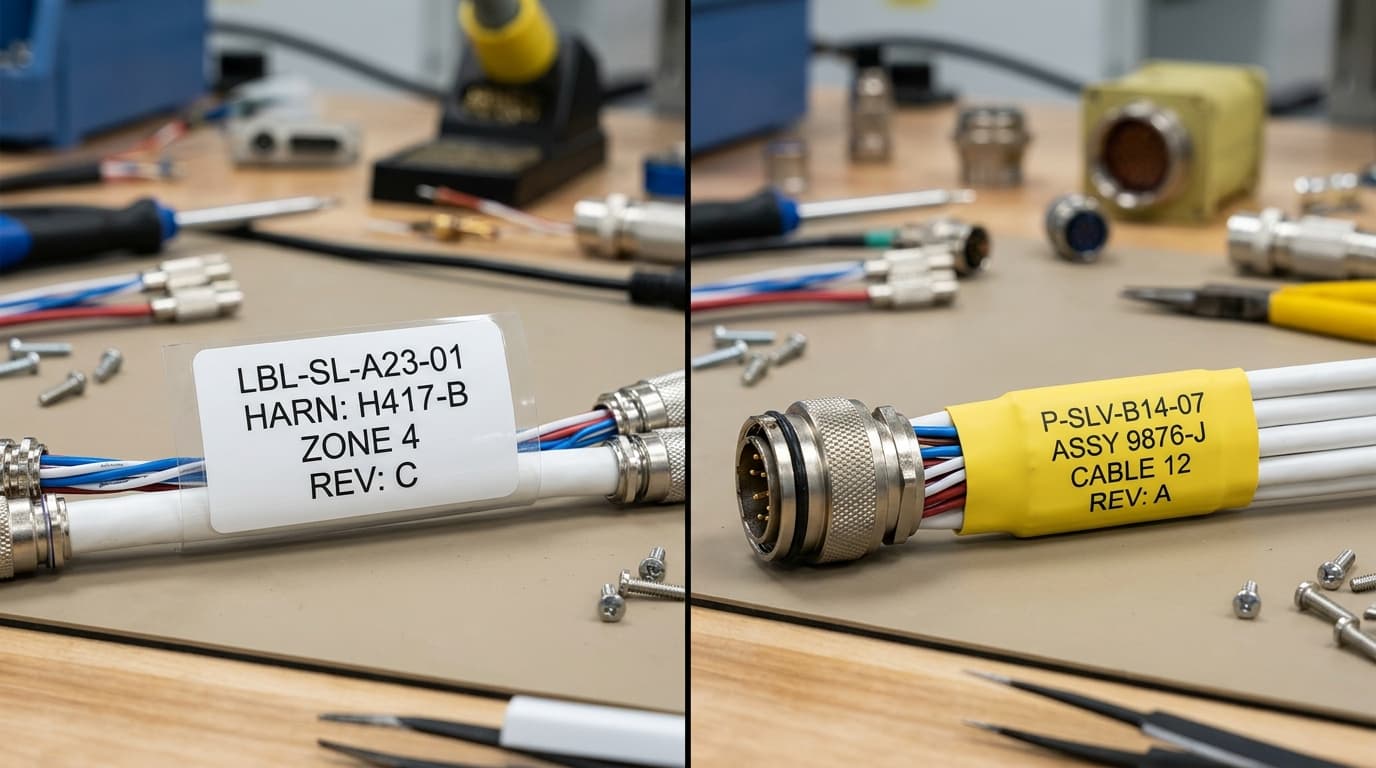
1. Workflow Stage Physics: Pre-Termination vs. Post-Termination
The primary physical constraint governing whether to specify B-427 or B-342 is the timing of installation relative to terminal connector assembly.
Pre-Termination Wire Assembly (Bench Harness Shop)
When wires are cut and stripped at an assembly bench before connector lugs, ferrules, or pins are crimped, B-342 sleeves slide freely over bare conductors. Full 360° heat shrink recovery provides permanent, tamper-proof mechanical locking with zero adhesive to degrade over decades.
Post-Termination & Field Retrofit (Installed Panels & Patch Cords)
Once terminal blocks, RJ45 jacks, heavy lugs, or D-sub connectors are installed, closed heat-shrink sleeves cannot fit over the connector head. B-427 wraps around the cable jacket with a white printable zone and a clear protective tail that overlaminates the text, eliminating connector disassembly.
2. Total Cost of Ownership (TCO) & Labor Economics
Material purchase price represents a fraction of total identification cost. Installation labor, dwell times, and field rework risks dictate actual economics.
| Economic Dimension | B-427 (Self-Laminating Vinyl Wire Wraps) | B-342 (PermaSleeve® 3:1 Heat-Shrink Polyolefin) |
|---|---|---|
| Average Material Unit Price | $0.14 / label | $0.28 / sleeve |
| Installation Labor Cost (@ $60/hr) | $0.20 (12 sec @ $60/hr labor) | $0.30 (18 sec slide + heat gun @ $60/hr) |
| Total Installed Cost | $0.34 / wire | $0.58 / wire |
| Rework Penalty / Failure Risk | $0.00 (Retrofits live wire) | $25.00+ (De-pin, cut, re-crimp, re-test lug) |
3. 15-Point Parametric Specification Diff
Direct ASTM laboratory metrics, operating limits, and physical mechanical properties extracted from verified Brady Technical Data Sheets (TDS).
| Technical Dimension | B-427 (Self-Laminating Vinyl Wire Wraps) | B-342 (PermaSleeve® 3:1 Heat-Shrink Polyolefin) | Key Advantage |
|---|---|---|---|
| Polymer Substrate Chemistry | Translucent Calendered Vinyl Film | Radiation Cross-Linked Irradiated Polyolefin (3:1 Shrink Ratio) | B-342 (Higher dielectric, heat & fluid resistance) |
| Attachment & Fastening Method | Pressure-Sensitive Permanent Acrylic (38 oz/in peel on SS) | Heat-Recovered Radial Mechanical Compression (3:1 ratio) | B-427 (No heat gun) / B-342 (Zero adhesive failure) |
| Continuous Service Temperature | -70°C to +70°C (-94°F to +158°F) | -55°C to +135°C (-67°F to +275°F) | B-342 (+65°C higher continuous thermal rating) |
| Short-Term High Temperature Limit | Discolors & softens at 100°C (212°F) | Survives 260°C (500°F) for 5 min; 180°C for 24 hours | B-342 (Aerospace & military engine bay capability) |
| Minimum Recovery / Activation Temp | Ambient (10°C / 50°F minimum application temp) | 150°C (302°F) heat gun recovery temperature | B-427 (Instant application with zero tools) |
| Print Protection Mechanism | Clear vinyl overlaminating tail wraps 360° over white text zone | Direct thermal transfer resin dye infusion into polyolefin tube | B-427 (Physical barrier) / B-342 (SAE AS-81531 permanent) |
| ASTM D1000 180° Peel Adhesion | 38 oz/in (20-min dwell) / 45 oz/in (24-hr dwell) on Stainless Steel | N/A (Non-adhesive mechanical sleeve) | B-342 (Immune to adhesive shear or edge flagging) |
| Dielectric Insulation Strength | Standard low-voltage wire wrap rating | 500 Volts/mil (ASTM D2671 / ASTM D876) | B-342 (Meets electrical insulation sleeve standards) |
| Flammability Rating | Self-extinguishing vinyl film | UL 224 Recognized (VW-1 Flame Retardant) | B-342 (Certified fire & flame retardant) |
| Military & Aerospace Approvals | RoHS & REACH Compliant | SAE AS-81531, SAE-AMS-DTL-23053/5 Class 1, MIL-STD-202G M215 | B-342 (Full military defense compliance) |
| UL Marking Certification | UL 969 Recognized (File MH17154) with R4300 / R7950 ribbons | UL 224 Recognized (File E333779) | Tie (Both UL Recognized for their designated classes) |
| Recommended Ribbon Formulation | Series R4300 Wax/Resin (or R4500 Red/Blue/Green) | Series R6600 High-Temp Pure Resin (R6700 White on Black) | R4300 (Economical) vs R6600 (Extreme Chemical Resin) |
| Automated Application Option | Brady Wraptor™ A6500 (Automated print & wrap in 5.0 seconds) | Manual sleeve insertion + heat gun pass | B-427 (Massive labor savings on high-volume production) |
4. Chemical Immersion & Harsh Solvent Head-to-Head
Standardized 5-cycle immersion testing (10-minute fluid exposure + 30-minute recovery period per ASTM protocols followed by cotton swab rub tests).
| Chemical Reagent | B-427 Observation | B-342 Observation | Outcome |
|---|---|---|---|
| Skydrol® 500B-4 Aviation Hydraulic Fluid | Failed (Destroys vinyl substrate & dissolves adhesive) | Passed (No visible effect on tube; slight rub fade, legible) | B-342 |
| JP-8 Aviation Jet Fuel | Moderate edge lift / adhesive degradation | Passed (No visible effect on tube; legible print) | B-342 |
| Methyl Ethyl Ketone (MEK) & Acetone | Not Recommended (Dissolves adhesive & vinyl) | Passed (No visible effect on tube; moderate print rub fade) | B-342 |
| MIL-H-5606 Hydraulic Oil | Moderate adhesive softening | Passed (Edge stained red; zero effect on printing) | B-342 |
| Isopropyl Alcohol (IPA 99%) | Passed (Protected by clear overlaminate tail) | Passed (No visible effect on tube or print) | Tie |
| Gasoline & Diesel Fuel | Temporary exposure tolerated; edge softening on immersion | Passed (No visible effect on tube; legible print) | B-342 |
| Super Agitene® Degreaser | Adhesive swelling / edge flag | Passed (No visible effect on tube; legible print) | B-342 |
| Deionized Water & Salt Fog (ASTM B117) | Passed (1000 hrs no effect) | Passed (1000 hrs 5% salt fog no effect) | Tie |
5. Wire Gauge Sizing Cross-Reference: Wrap Height vs. Sleeve Diameter
Conversion table mapping American Wire Gauge (AWG) outer diameters to exact B-427 self-laminating label dimensions (applying the formula H = π × D_OD + 0.30") and B-342 3:1 expanded/recovered sleeve diameters.
| Wire Gauge (AWG) | Cable Outer Diameter (OD) | Recommended B-427 Size | Recommended B-342 Sleeve |
|---|---|---|---|
| 28–24 AWG | 0.030" – 0.060" (0.76 – 1.52 mm) | 0.50" W x 0.75" H (Print: 0.375" H) | 0.094" (3/32") 3:1 Sleeve (0.031"–0.094" OD) |
| 22–18 AWG | 0.060" – 0.100" (1.52 – 2.54 mm) | 0.50" W x 1.00" H (Print: 0.375" H) | 0.125" (1/8") 3:1 Sleeve (0.046"–0.125" OD) |
| 16–14 AWG | 0.095" – 0.145" (2.41 – 3.68 mm) | 0.75" W x 1.00" H or 1.00" W x 1.25" H | 0.187" (3/16") 3:1 Sleeve (0.062"–0.187" OD) |
| 12–10 AWG | 0.135" – 0.215" (3.43 – 5.46 mm) | 1.00" W x 1.50" H (Print: 0.500" H) | 0.250" (1/4") 3:1 Sleeve (0.094"–0.250" OD) |
| 8–6 AWG | 0.220" – 0.320" (5.59 – 8.13 mm) | 1.00" W x 1.75" H or 1.50" W x 2.00" H | 0.375" (3/8") 3:1 Sleeve (0.125"–0.375" OD) |
| 4–2 AWG | 0.335" – 0.440" (8.51 – 11.18 mm) | 1.50" W x 2.50" H or 2.00" W x 3.00" H | 0.500" (1/2") 3:1 Sleeve (0.187"–0.500" OD) |
| 1/0–4/0 AWG | 0.485" – 0.640" (12.32 – 16.26 mm) | 1.50" W x 3.75" H or 2.00" W x 4.00" H | 1.000" (1") 3:1 Sleeve (0.375"–1.000" OD) |
| 250–500 MCM | 0.710" – 0.950" (18.03 – 24.13 mm) | 2.00" W x 5.00" H (Print: 1.000" H) | 1.500" (1-1/2") 3:1 Sleeve (0.500"–1.500" OD) |
6. Failure Modes: When to NEVER Use B-427 vs. B-342
Critical engineering boundary limits where material physics fail under extreme environmental, mechanical, or chemical stress.
- Continuous ambient temperatures exceeding 70°C (158°F) such as vehicle engine bays or industrial ovens.
- Total immersion in harsh solvents (Skydrol aviation hydraulic fluid, MEK, acetone) which dissolve the acrylic adhesive.
- Direct contract specifications mandating SAE AS-81531 or MIL-STD-202G Method 215 compliance.
- Retrofitting wires after connectors, lugs, RJ45 plugs, or terminal pins are already crimped or soldered.
- Heat-sensitive optical fiber or thin-jacketed data lines where a 150°C heat gun could melt internal conductors.
- Tight budget applications where heat guns and operator dwell times cannot be accommodated.
7. Hardware Intelligence: Thermal Transfer Ribbon Formulation & Printers
A high-performance rating plate or wire marker is only as durable as the thermal transfer ribbon chemistry paired with it.
Engineering Decision FAQ: B-427 vs. B-342
Because standard RJ45 modular plugs are significantly wider than the cable diameter (approx. 0.46" connector vs. 0.22" cable). A heat-shrink sleeve that fits over the RJ45 plug would not recover down tightly on the cable even with a 3:1 shrink ratio. B-427 wraps around the cable jacket directly behind the boot with zero connector interference.
B-342 requires Brady Series R6600 high-temperature pure resin ribbon. If printed with standard wax or wax/resin ribbons, the print will fail the SAE AS-81531 eraser rub test (500g force) and will smear or wash off under petroleum or solvent exposure.
Yes! Brady manufactures the Wraptor™ A6500 Wire Identification Machine, which prints and applies B-427 self-laminating labels around cables in 5.0 seconds flat—eliminating manual peeling and wrapping.
Yes, but under different standards: B-427 is Recognized under UL 969 (Marking and Labeling Systems, File MH17154), while B-342 is Recognized under UL 224 (Extruded Insulating Tubing, VW-1 Flammability, File E333779).