Labeling Liquid Nitrogen Cryo Vials & Frozen Glass/Plastic: Engineering Guide
Standard acrylic adhesives frequently fail on liquid nitrogen cryo vials & frozen glass/plastic due to low critical surface tension, microscopic texture voids, or severe temperature extremes. This guide outlines the molecular mechanics of adhesion and specifies high-tack Brady formulations engineered to prevent peeling.
Standard pressure-sensitive adhesives reach their glass transition temperature (Tg) around -20°C to -40°C, becoming brittle like glass. When submerged in liquid nitrogen (-196°C / -320°F) or -80°C freezers, the rigid adhesive shatters and pops off the vial during thermal expansion cycles.
Ultra-low-Tg cryogenic acrylic adhesives that remain elastomeric and flexible down to -196°C, formulated with moisture-displacing tackifiers that bond directly through surface frost and condensation on frozen polypropylene vials and glass slides.
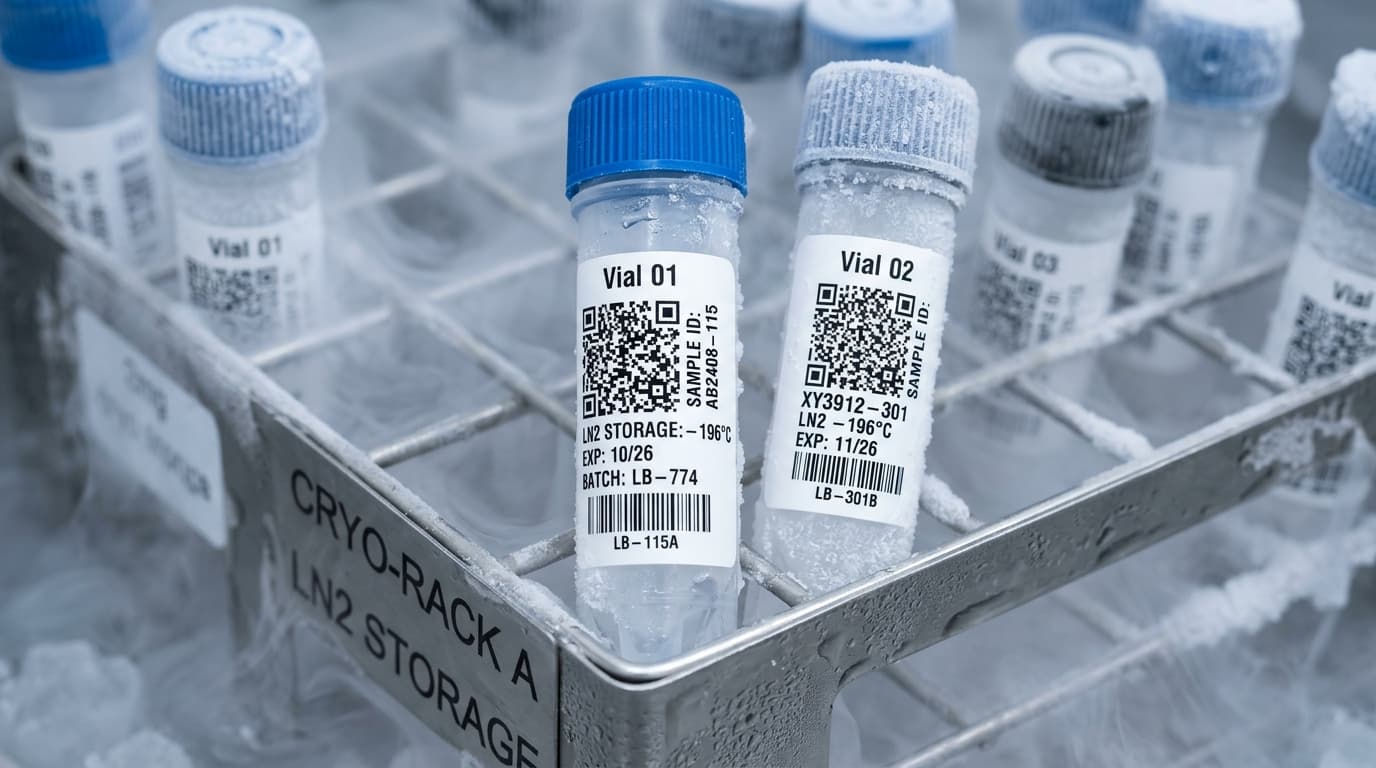
Recommended Brady Materials for Liquid Nitrogen Cryo Vials & Frozen Glass/Plastic
FreezerBondz™ Cryogenic Polyester
Engineered specifically to apply directly to already-frozen vials without thawing, wiping frost, or losing biological sample integrity.
FreezerBondz™ Wrap-Around Cryo Film
Wraps around 0.5 mL to 2.0 mL microcentrifuge tubes and cryo vials, withstanding high-speed centrifugation (10,000+ RPM) and autoclave cycles.
Orderable Part Numbers for Liquid Nitrogen Cryo Vials & Frozen Glass/Plastic
Pre-sized rolls and cartridges engineered for guaranteed surface adhesion.
Surface Preparation & Application Protocol
Wipe the surface with a 50/50 mixture of Isopropyl Alcohol (IPA) and clean deionized water using a lint-free cloth. Allow the surface to dry completely. For oily or greasy metals, a degreaser solvent like heptane may be used first, followed by an IPA wipe to remove residual solvent film.
Pressure-sensitive adhesives require mechanical force (minimum 15 psi) to displace air pockets and force the polymer into the valleys of textured paint. Adhesives achieve ~50% bond strength immediately, but require a 72-hour dwell time to fully wet out and achieve maximum ASTM D1000 peel adhesion.