Cartridge vs. Bulk: The Supply Decision Hiding Inside the Printer Decision
Buying a label printer quietly commits you to a supply model for its whole service life — keyed cartridges that anyone can swap in seconds, or open-core bulk rolls that cost a fraction per label and demand a real operator. Neither is "better"; they optimize opposite things (labor at the point of use vs. media cost at volume), and the honest analysis is a volume-and-who question, not a price-tag question.
1. The Two Ecosystems, Side by Side
| Factor | Keyed Cartridge | Open-Core Bulk |
|---|---|---|
| Loading & changeover | Seconds, gloved hands, impossible to load wrong | Minutes: web the media path, load ribbon, verify sensor |
| Calibration & scrap | Auto-configured from the cartridge — near-zero setup scrap | Sensor calibration per media change; first-labels scrap is real |
| Cost per label | Premium — you are paying for the ecosystem | Lowest — media cost approaches raw converting |
| Format flexibility at the point of use | Swap formats in seconds between jobs | Format changes are a deliberate operation — batch your work |
| Who operates it | Anyone, immediately — electricians, techs, lab staff | A trained operator or a print-room owner |
| Natural tier | M210 → M710 handhelds; auto-calibrating i3300 | BBP12 value desktop; i5100/i7100 production engines |
2. Run the Fully Loaded Number, Then Split the Fleet
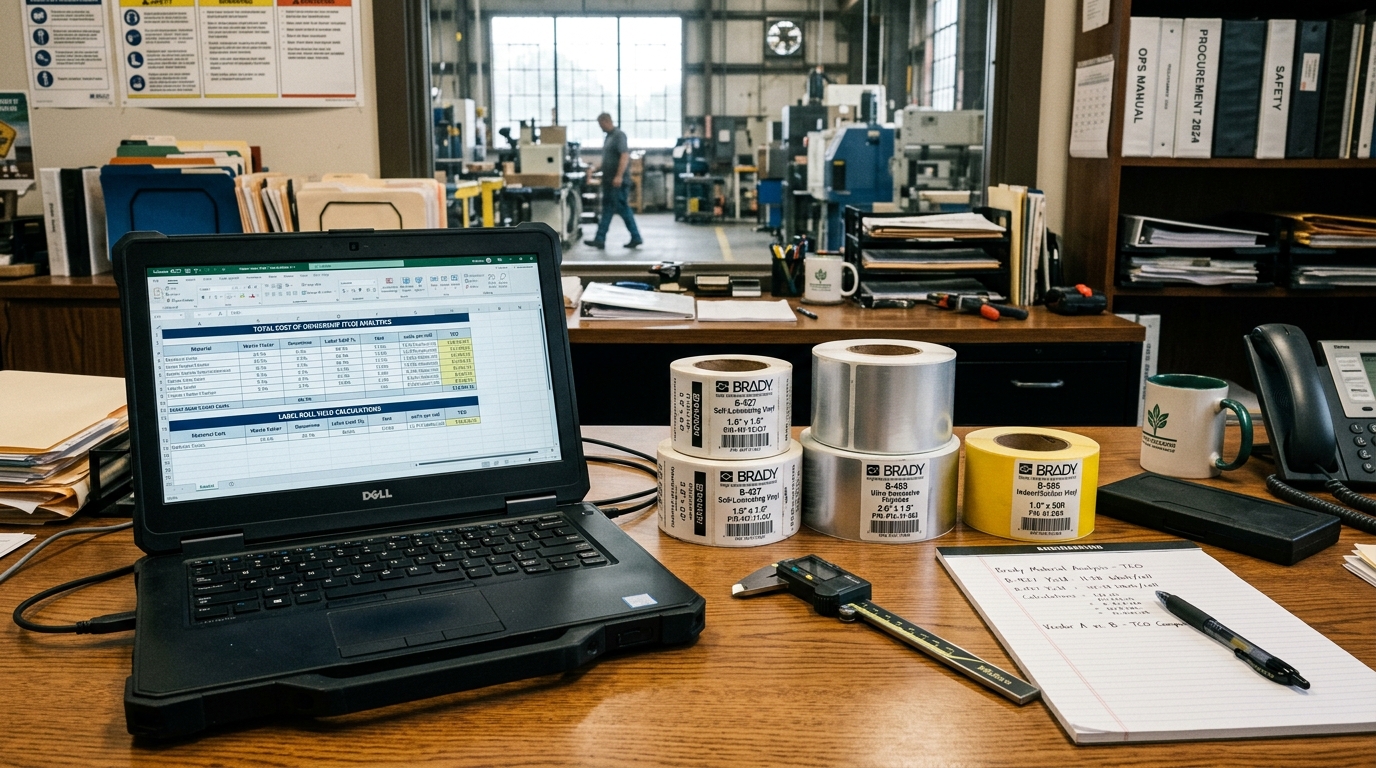
Cost per applied label = media + (loading minutes × loaded labor rate ÷ labels per load) + setup scrap + mis-load scrap. Run it for your top three label formats at your real volumes — the Label Cost Calculator does the arithmetic — and the fleet usually splits itself:
- Point-of-work, intermittent, many formats → cartridge handhelds (M-series) where the premium buys eliminated friction.
- Concentrated batch volume → one open-core machine (BBP12 value tier, i5100/i7100 at production scale) as the facility print room.
- Standardize material FAMILIES across both formats — same B-427/B-595/B-423 chemistry either way — so durability never depends on which printer made the label.
- Batch the batchable: location label projects, signage refreshes, and nameplate runs belong on the bulk machine even when a cartridge printer sits closer.
Bulk economics assume competent loading. Every mis-webbed roll, backward ribbon, and un-calibrated first batch is invisible spend — and it lands exactly where the print quality troubleshooting guide picks it up. If the bulk machine has no owner, its savings are theoretical.
Do the math on your actual volumes
The Label Cost Calculator compares supply formats across your annual label volume, with labor and scrap in the model.