ESD Labeling: When the Label Itself Is the Static Hazard
An ESD program measures wrist straps daily and floors quarterly — then routes standard insulative labels through the same protected area by the thousand. Peeling one off its liner is a kilovolt-class triboelectric event centimeters from devices that die at tens of volts. The fix is a material class most spec sheets never mention: static-dissipative label constructions, plus disciplined use of the two ESD symbols that mean opposite things.
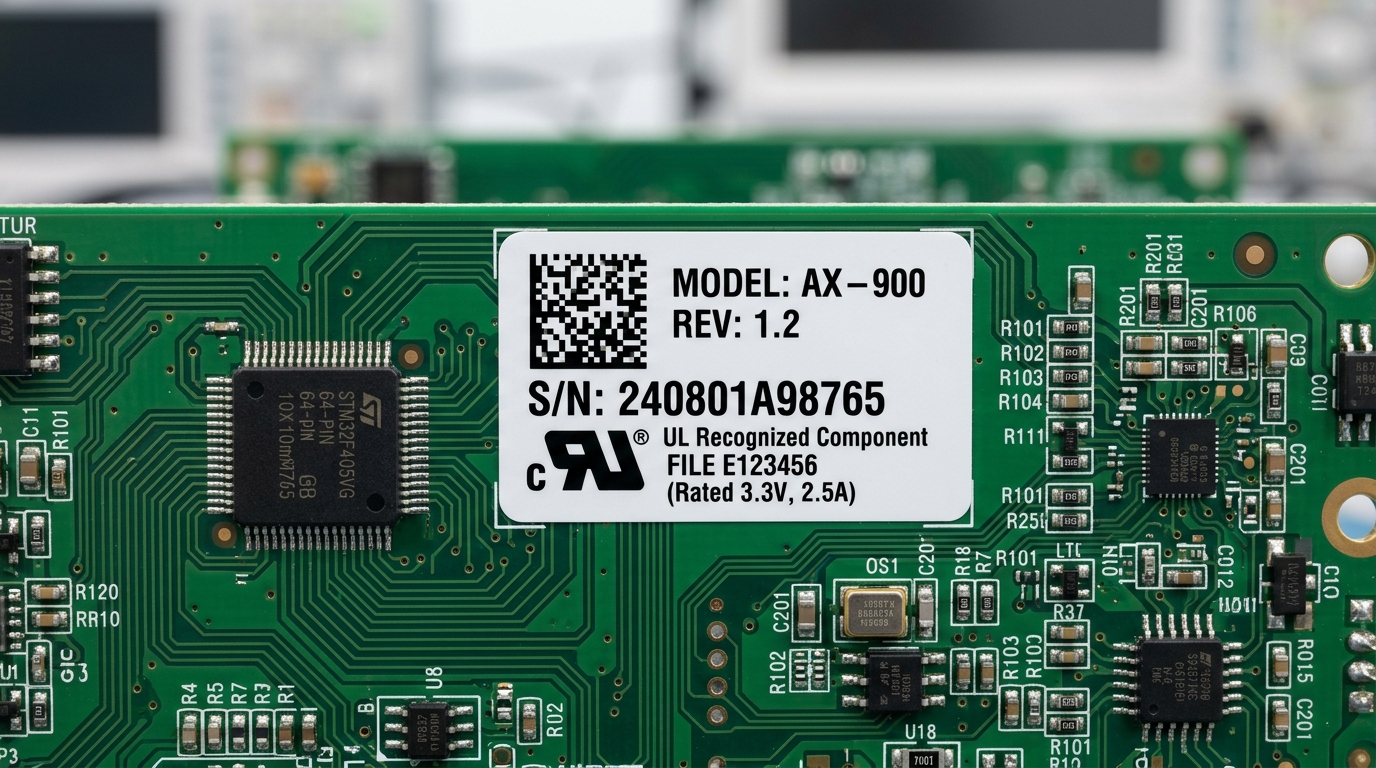
1. The Two Failure Paths a Standard Label Opens
Liner separation and peel-off are textbook tribocharging. Do it over an open assembly and the field couples straight into the board. Dissipative constructions keep the generated charge bleeding away through the handler's grounded skin or the bench instead of accumulating on the film.
S20.20-style programs restrict nonessential insulators near ESD-sensitive work. A standard PET label permanently mounted on a tote, tray, or fixture is an insulator in the EPA — small, but multiplied across every carrier in the line. Dissipative label stock removes the exception paperwork.
The catalog backs this with a real tier: nine material families carry static-dissipative permanent acrylic adhesive systems — the dissipative property engineered into the construction, not sprayed on after.
2. Stocks and Symbols
Board and component marking applied inside the ESD workflow.
Reflow-surviving PCB marking where the thermal spec dominates.
Finished-assembly rating plates and serial tags, outside the sensitive zone.
Susceptibility (slashed hand in triangle) = "this can be killed by static" — goes on boards, modules, and their immediate packaging. Protective (arc over hand) = "this protects against static" — goes on dissipative bags, totes, and mats. Auditors read the difference; so should the label templates. EPA boundary signage ("ESD Protected Area — wrist straps required") is standard Z535-format work on B-595.
The full PCB labeling stack
The circuit board portal covers reflow-surviving polyimides, 600 DPI micro-barcodes, and defluxer chemistry — the rest of the electronics marking story.