Food & Beverage Labeling: Built for the Nightly Washdown
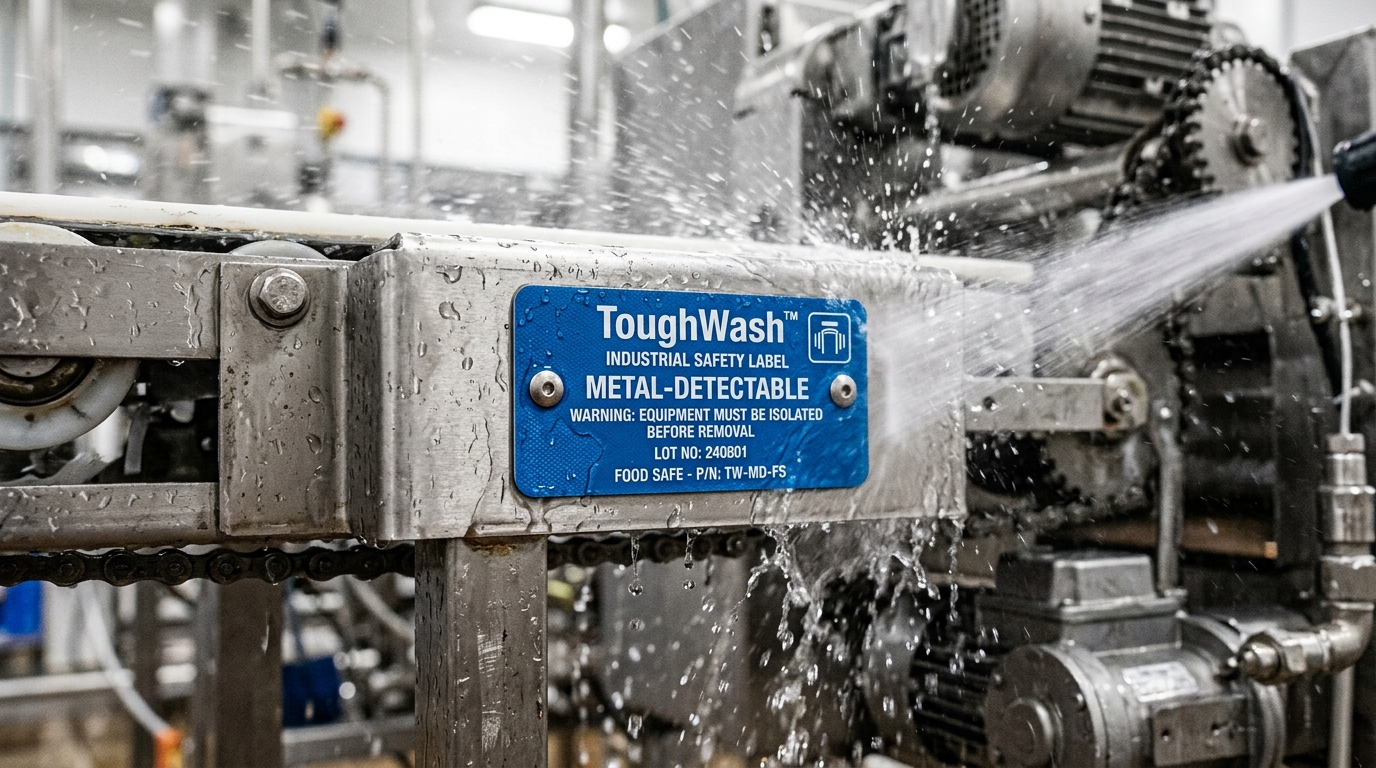
Every label in a wet-process room gets chemically attacked on schedule, every night, forever — hot caustic foam, sanitizer, then a pressure rinse that finds every lifted edge. Labeling a food plant is therefore not one spec but a zone map: what survives the washdown room is overkill in the warehouse, and what works in the warehouse is foreign-material risk in the washdown room.
1. Spec by Zone, Not by Plant
Hygienic zoning already divides the facility; let the label spec follow the same map:
| Zone | What Attacks the Label | Spec |
|---|---|---|
| Wet process / washdown rooms | Nightly caustic + sanitizer + pressure rinse | B-854 washdown polyester, resin print, full-perimeter adhesion, radiused corners |
| Dry process & packaging | Dust, conveyor abrasion, occasional wipe-down | B-423 gloss polyester class with resin ribbon |
| Cold rooms & freezers | Condensation at application, frost cycling | FreezerBondz tier — covered in the freezer labeling guide |
| Utility & mechanical spaces | Standard industrial exposure | B-595 vinyl for pipe marking and signage per ASME A13.1 |
Key stocks: B-854 washdown polyester (-40°C to +110°C) in the wet rooms, B-423 in dry process, B-595 for utility marking — with reagent-level verification in the chemical resistance database.
2. The Details a Food-Safety Audit Actually Checks
- No lifting edges anywhere in product zones — a peeling label is simultaneously foreign-material risk and moisture harborage. Treat lift as a work order, not cosmetics.
- Labels off direct product-contact surfaces, full stop; identify the frame, guard, or panel instead.
- Full-perimeter, bubble-free application (the adhesive guide technique) so sanitation chemistry finds no bond line to work.
- Hygienic zone color coding carried on the labels themselves — zone-colored fields sort tools, totes, and equipment at a glance the same way TIA colors sort a network frame.
- Chemical container and secondary-vessel labeling per the GHS guide — sanitation chemicals are the most-handled hazardous materials in the building.
- Documentation labels (cleaning status tags, line clearance) on removable or repositionable stock so status changes do not leave residue archaeology.
Sanitation chemistry varies plant to plant — concentration, temperature, contact time. The honest qualification is a month of real cycles on a sacrificial labeled panel in your worst room. It costs one label and answers the question permanently.
Check your sanitizers against the data
The chemical resistance database maps tested material-versus-reagent outcomes — look up your caustic, acid, and sanitizer classes before standardizing a stock.