GHS Secondary Container Labeling: What OSHA Actually Requires
Hazard Communication is OSHA's most-cited standard year after year, and unlabeled secondary containers — the spray bottle of diluted degreaser, the parts-washer reservoir, the squeeze bottle of IPA at every bench — are the easiest citation on the list. The rules are less demanding than most safety managers assume, but they are unforgiving about two things: the container-to-SDS chain, and legibility over time.
1. Shipped Containers vs. Workplace Containers: Different Rules
The full six-element GHS label is a manufacturer obligation on shipped containers under 1910.1200(f)(1). Once the chemical is decanted in your facility, you are in (f)(6) territory, where OSHA deliberately allows a simpler system. Employers get two compliant paths:
Reproduce the full GHS format: identifier, signal word, H-statements, pictograms, P-statements. One system everywhere, zero training ambiguity, and the approach most corporate EHS programs mandate. Requires two-color printing or pre-printed diamond stock.
Product identifier plus words, pictures, symbols, or combination thereof that convey the specific hazards — legacy systems like HMIS/NFPA 704 bars survive here, provided the written program ties the codes to SDS access and training covers them.
A portable container needs no label only when the transferring employee keeps it under their control and empties it within the same shift. The unlabeled bottle found on a bench Monday morning is, by definition, out of the exemption — and it is exactly what inspectors photograph.
2. The Six Shipped-Label Elements (Option A Checklist)
If your program mirrors shipped labels, these six elements come straight off the SDS (Sections 1 and 2). The pictogram rule trips people up: the red diamond frame is mandatory, and an empty red frame is a violation on shipped containers — print only the diamonds that apply.
| Element | Field Notes |
|---|---|
| 1. Product identifier | Must match the SDS Section 1 name exactly — the chain from container to SDS is the whole point. |
| 2. Signal word | DANGER or WARNING — one only, driven by the most severe hazard class. |
| 3. Hazard statement(s) | Standardized H-phrases: “Highly flammable liquid and vapor” (H225), never freelanced wording. |
| 4. Pictogram(s) | Red diamond frame, black symbol, white field — hollow red frames with nothing inside are prohibited on shipped containers. |
| 5. Precautionary statement(s) | P-phrases covering prevention, response, storage, disposal. |
| 6. Supplier identification | Name, address, phone of the manufacturer, importer, or responsible party. |
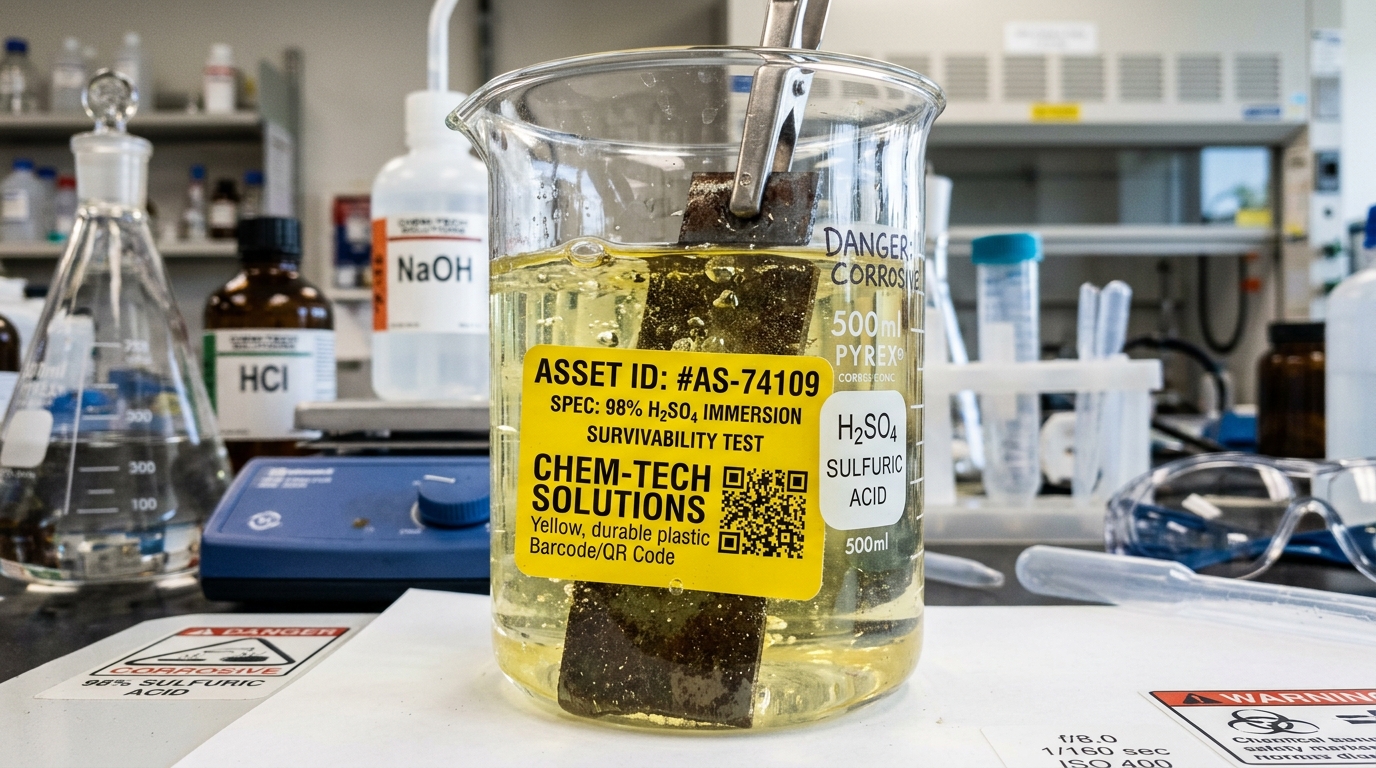
3. The Label Must Survive the Chemical It Names
This is where secondary container programs actually fail. The regulation says labels must be legible — and a laser-printed paper label on an acetone bottle is illegible within weeks of normal drip-and-wipe handling. Compliance is a materials problem:
- Solvent squeeze bottles & benchtop containers: B-423 gloss polyester (-70°C to +110°C, UL 969 recognized, file MH17154) printed with a full resin ribbon — the print becomes part of a solvent-resistant film, not ink sitting on paper.
- Wash-down and wet process areas: B-854 polyester holds through -40°C to +110°C and repeated wash cycles on drums and totes.
- Curved small-diameter vials and bottles: conformable materials matter more than chemistry — see the lab-focused options in our laboratory application portal.
- Verify against the actual reagent: our chemical resistance database maps tested material-versus-reagent outcomes from the TDS data rather than marketing copy.
For printing the red diamonds in-house, a two-color capable sign printer (i5300 class) handles frame and legend in one pass; single-color shops standardize on pre-printed diamond stock and add black text.
Does your label stock survive your chemistry?
Look up tested resistance data for the exact reagents in your facility — acetone, IPA, xylene, battery acid — across every Brady material family.