Arc Flash Label Requirements: NFPA 70E 130.5(H) & NEC 110.16
Two different documents govern the orange label on your switchgear, and they demand different things. The NEC tells the installer to warn that a hazard exists; NFPA 70E tells the facility to quantify it. This guide covers exactly what goes on the label, which equipment needs one, who owns the obligation, and why the 5-year study review clock is the real reason to print labels in-house.
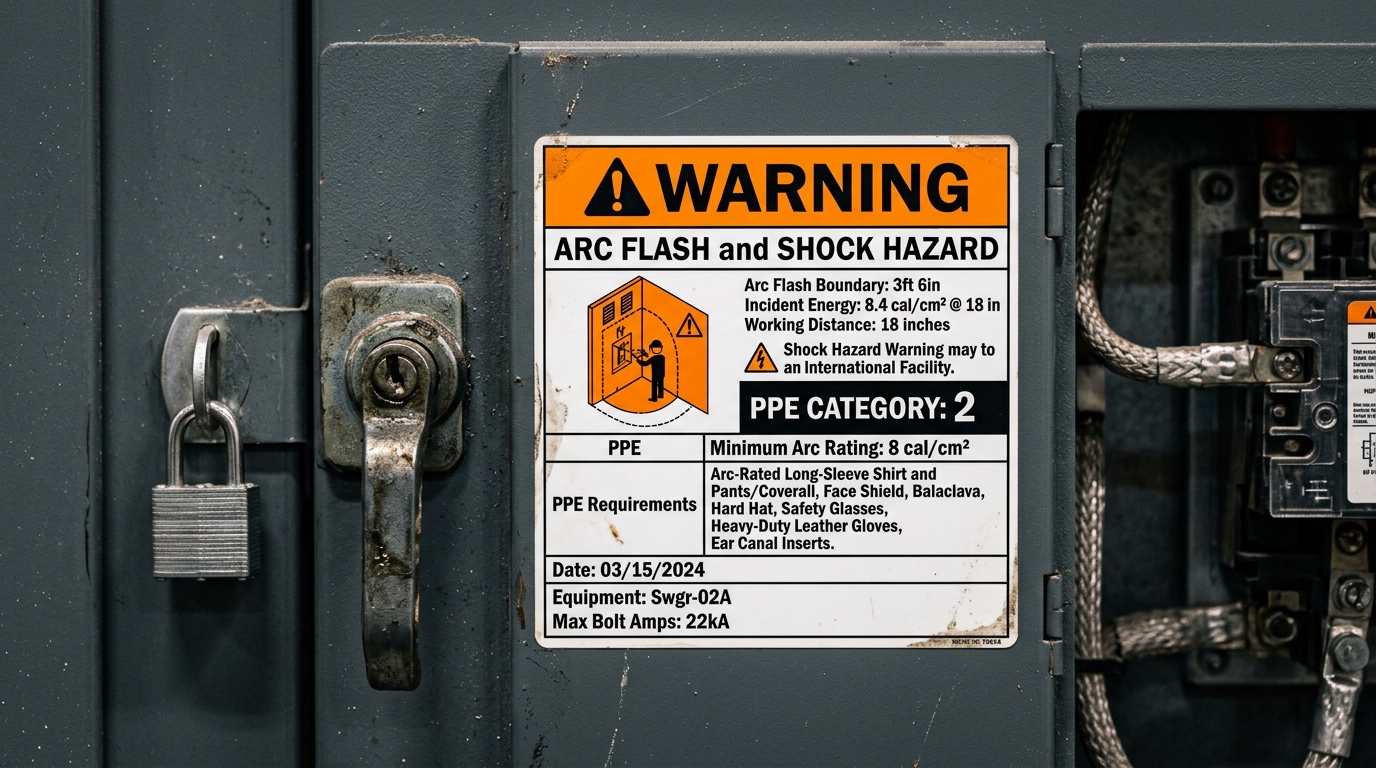
1. NEC 110.16 vs. NFPA 70E 130.5(H): Two Different Labels
Confusing these two is the most common labeling error we see in panel shops. The NEC label is applied at installation, before any study exists. The NFPA 70E label is applied after the facility performs its arc flash risk assessment — and it is the one OSHA inspectors ask about under the General Duty Clause.
NEC 110.16(A) — Generic Field Warning
Switchboards, panelboards, industrial control panels, meter socket enclosures, and motor control centers in other-than-dwelling occupancies must be field-marked to warn qualified persons of potential arc flash hazards. No numbers required — a durable "Warning: Arc Flash and Shock Hazard" decal satisfies it. Applied by the installer or the UL 508A panel builder.
NFPA 70E 130.5(H) — Site-Specific Data Label
Equipment likely to require examination, adjustment, servicing, or maintenance while energized must carry the quantified label: nominal voltage, arc flash boundary, and the PPE selection data from the site study. This is the label that changes when the study changes — see the 5-year clock in Section 3.
NEC 110.16(B) adds a separate requirement for service equipment rated 1,200 A and above: available fault current, the clearing time of the service overcurrent device, and the date the calculation was performed — unless the equipment already carries a compliant 70E-style label.
2. Required Label Content Under 130.5(H)
Three mandatory data points, one formatting rule (the label must be an ANSI Z535-style hazard label — see our ANSI Z535 color standard guide), and one trap: pick incident energy or PPE category, never both.
| Label Field | Example Entry | Why It Is On The Label |
|---|---|---|
| Nominal system voltage | 480 V, 3Ø | Sets the shock protection approach and glove class before the door is opened. |
| Arc flash boundary | 42 inches | The distance at which incident energy falls to 1.2 cal/cm² — the line where unprotected skin risks a second-degree burn. |
| Incident energy + working distance OR PPE category | 8.1 cal/cm² @ 18 in — or — PPE Category 2 | One method only, never both. This single line drives the arc-rated clothing decision. |
| Recommended (not mandated): study date, equipment ID, shock boundaries | Study: Mar 2026 · MCC-4A · LAB 42 in / RAB 12 in | The study date is what auditors use to check the 5-year review clock without pulling the engineering report. |
3. The 5-Year Review Clock Is a Labeling Problem, Not Just an Engineering Problem
NFPA 70E requires the incident energy analysis to be reviewed at intervals not exceeding 5 years — and re-done whenever a change (utility available fault current, transformer replacement, breaker trip settings, added motor contribution) could alter the results. Every review that moves a number obsoletes the physical label on the gear. A 400-bus facility that outsourced engraved phenolic arc flash plates at $8–$15 each faces a four-figure invoice and a multi-week lead time on every study cycle.
This is why arc flash labeling has standardized on thermal-transfer printed vinyl: the study engineer exports the bus list, and the maintenance team prints the full replacement set in an afternoon on a benchtop sign printer.
Brady B-595 industrial vinyl — 4.0 mil, permanent acrylic adhesive, -40°C to +82°C service range, 515 catalog SKUs in facility widths. The workhorse for indoor electrical rooms.
A 4-inch sign printer — S3100 or multi-color i5300 — produces the orange WARNING / red DANGER header panels in-house instead of relying on pre-printed header stock.
Outside face of the door or cover, legible before the worker opens it or begins interaction — one label per section on multi-section switchboards and MCCs, not one per lineup.
4. Pre-Audit Walkdown Checklist
- Every panelboard, switchboard, MCC, industrial control panel, and disconnect likely to be worked energized carries a 130.5(H) data label — not just the generic NEC 110.16 decal.
- No label mixes incident energy with a PPE category. One method per bus, consistent across the facility.
- The study date on the labels is inside the 5-year window, and matches the current engineering report revision.
- Services 1,200 A and up show available fault current, clearing time, and calculation date per NEC 110.16(B).
- Labels are adhered to painted enclosure doors — not to removable dead-fronts that get swapped between sections during maintenance.
- Vinyl stock is rated for the environment: standard B-595 indoors; wash-down or outdoor gear needs the UV-stable materials covered in our outdoor durability guide.
Building or re-labeling a panel to pass inspection?
The Panel BOM Builder injects the mandatory arc flash, SCCR, and PE grounding decals into your label schedule automatically, alongside the wire marker roll counts.