Security & Asset Integrity
Tamper-Evident Labels: Three Mechanisms, Three Different Kinds of Proof
"Tamper-evident" is not one technology — it is three, and they leave their evidence in different places: in the shredded label, on the marked surface, or in the disturbed seal. Pick by asking where the proof has to survive, then close the loop the mechanism cannot: serialization. A tamper label without a unique number only proves a label was removed — not that this one was swapped.
Sponsored Security Identification
Industrial Label Printers & Materials
Relevant Technical Equipment & Consumables [Ad Slot tamper-top]
1. The Three Mechanisms
How it works
The film is engineered weak — it fragments on any removal attempt, coming off in confetti rather than one piece.
Where it wins
Asset tags and seals that must never transfer to another item: the tag dies before it moves.
Limits
Slow to remove legitimately too — decommissioning is scraping work.
How it works
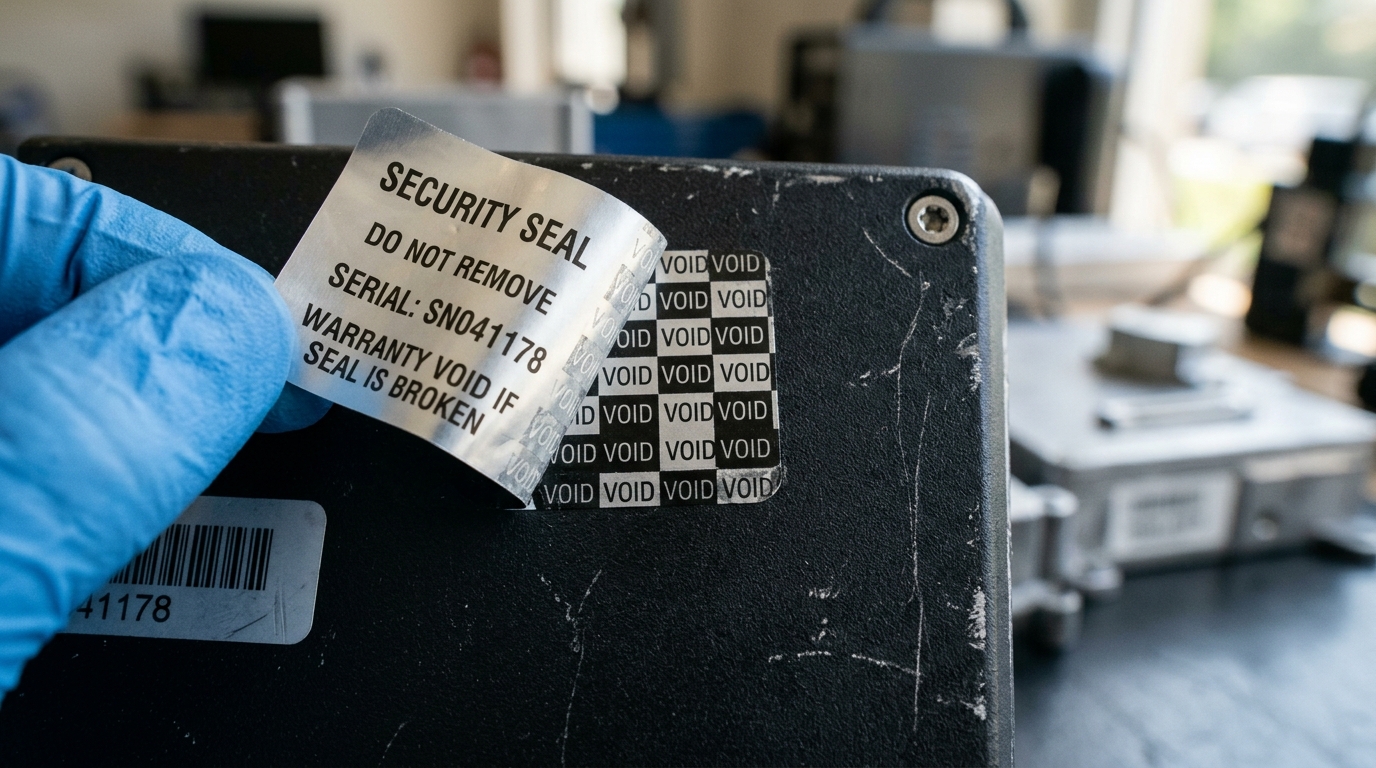
Layers separate on removal, leaving a residue pattern on the surface while the face stock lifts away.
Where it wins
Enclosure seals and warranty closures — the surface itself testifies after the label is gone.
Limits
Residue behavior depends on the surface; validate on your actual substrate and dwell.
Tamper-indicating clear sealB-7566 gloss clear polyesterServes from -94°C · tamper-indicating acrylic
How it works
A clear over-seal with tamper-indicating adhesive — applied across joints, lids, and closures so opening disturbs it visibly.
Where it wins
Sealing over existing printed content or serial plates without obscuring them; cold-chain seals.
Limits
Clear film demands clean application — trapped bubbles read as tamper artifacts.
2. Designing the Program Around the Label
- Serialize every seal — sequential or barcode serials printed at issue, logged against the asset or work order. The mechanism proves interference; the serial proves substitution.
- Position across the joint that matters: a seal on a flat face proves nothing about the lid. Enclosure seals bridge door-to-frame; battery covers get the seal across the seam.
- Validate on the real surface and dwell time — residue and fracture behavior are surface- and cure-dependent, exactly like every adhesive property in the adhesive selection guide.
- Write inspection into the process. Seals audit themselves never; a five-second check at receiving, calibration, or shift start is the half of the system paper cannot replace.
- For high-value assets, combine mechanisms: destructible serialized tag on the asset, residue seal across the service closure.
Tamper-evidence is not tamper-proofing
These labels detect and deter; they do not resist. Anything sold as "tamper-proof" is marketing. The security value is the audit trail: numbered seals, logged, inspected — with the label as the visible tripwire.
Serialization is the other half
The asset tracking portal covers serial number schemes, durable tag materials, and the barcode engineering that makes numbered seals auditable at scale.