Thermal Transfer vs. Direct Thermal: Which Technology, When
Both technologies use the same printhead physics — a row of resistive dots firing heat pulses — but what the heat does is completely different, and that difference decides whether your label is still legible in ten years or blank in ten months. Here is the mechanism, the failure modes, and the honest case for each side.
1. Head-to-Head: The Seven Parameters That Matter
The pattern in this table is not subtle — thermal transfer wins everything related to survival, direct thermal wins everything related to operational simplicity. The spec decision is just deciding which of those your application is about.
| Parameter | Thermal Transfer (Ribbon) | Direct Thermal (Coated Stock) | Verdict |
|---|---|---|---|
| Image formation | Resin/wax ink transferred from ribbon and bonded to the label surface | Leuco dye + developer in the paper coating react to printhead heat | TT image is an applied material; DT image is a reversible chemical state |
| Heat exposure in service | Stable to the label stock limit (polyester to +110°C, polyimide to +330°C) | Backgrounds gray then blacken with ambient heat; B-813/B-816 rated only -40°C to +60°C | TT |
| UV / sunlight | Resin prints are UV-stable; substrate is the limiting factor | Printed image fades; not recommended outdoors at all | TT |
| Chemical & abrasion resistance | Resin ribbons survive IPA, MEK wipe-downs, and eraser-rub testing | Solvents and plasticizers attack the imaging layer directly | TT |
| Consumable cost & changeover | Label + ribbon; ribbon adds cost and a second SKU to stock and load | Label only; no ribbon outages, faster media swaps | DT for short-life volume work |
| Printhead life | Ribbon back-coat shields the head from media abrasion | Head contacts coated paper directly; expect shorter service intervals | TT |
| Certifications (UL 969 etc.) | UL/CSA recognitions are granted to material + specific ribbon pairings | Not the technology used for recognized rating/nameplate applications | TT |
2. Decision Checklist
- The label must outlive a product, wire, panel, or stored specimen — years, not weeks.
- Heat above 60°C, sunlight, or solvents will touch the label at any point in its life.
- A certification is in play: UL 969 recognitions attach to material + ribbon pairings.
- You are printing on anything other than paper — polyester, vinyl, polyimide, heat-shrink.
- Label life is measured in days: shipping, cross-dock, WIP travelers, cafeteria date codes.
- Ribbon changeover time or ribbon-out stoppages are a real line-rate constraint.
- The environment is indoor, ambient, and dry from print to disposal.
- You accept the trade in writing — B-813 (permanent) and B-816 (removable adhesive) direct thermal papers are rated to +60°C, indoors, and Brady explicitly does not recommend them for heat, humidity, or outdoor exposure.
The catalog tells the story numerically: of the 603 Brady material families we track, exactly two — B-813 and B-816 — are direct thermal. Industrial identification is a thermal transfer world, and the ribbon pairing is where the real engineering lives: see the ribbon compatibility chart.
Committed to thermal transfer? Match the ribbon next.
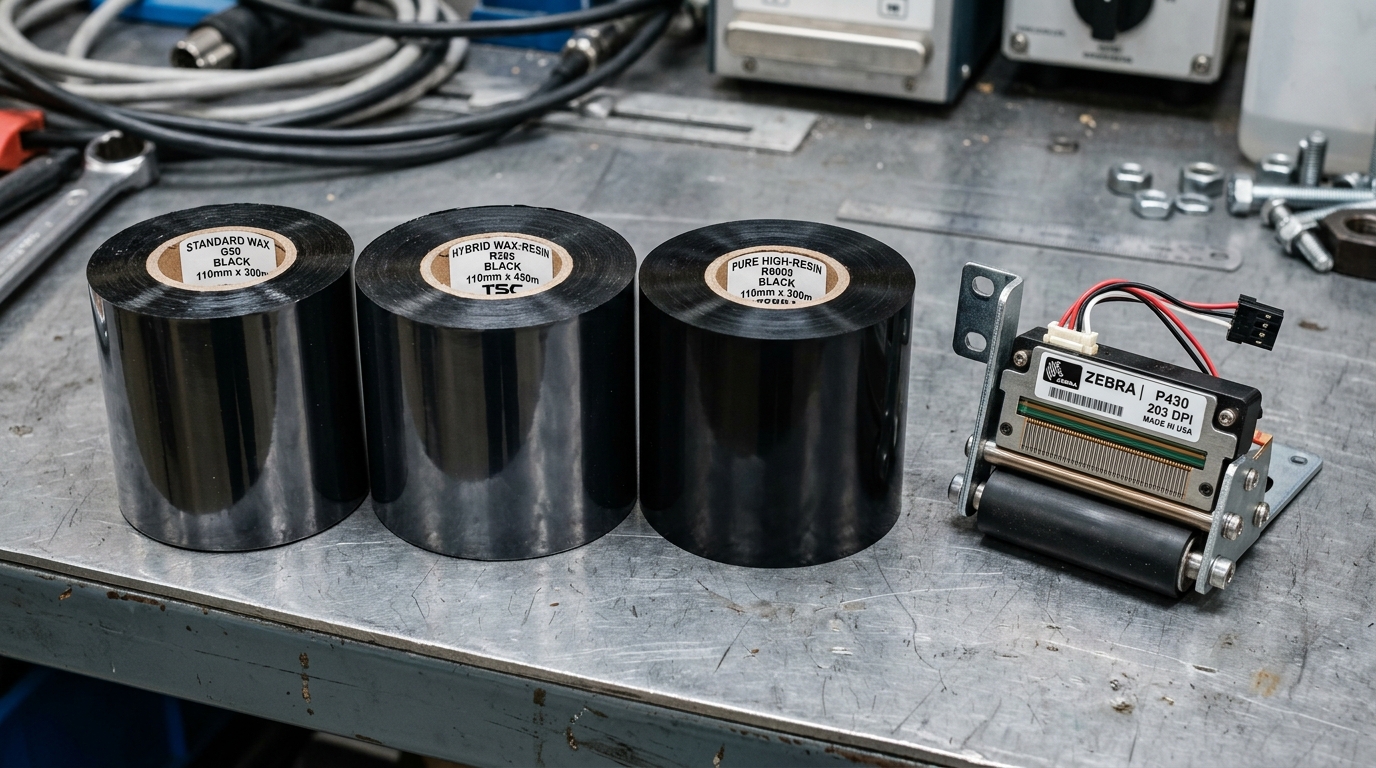
The wrong ribbon on the right material fails the same tests as the wrong material. The Ribbon Finder pairs your B-number with its tested wax/resin or full-resin series.