Brady B-423 vs. B-428 Comparison
High-Contrast White Barcode Reflectance vs. Brushed Aluminum Metallic Equipment Rating Plates. This in-depth technical analysis provides side-by-side engineering data, ASTM laboratory adhesion scores, operating temperature thresholds, chemical immersion resistance, and Total Cost of Ownership (TCO) models.
Choose B-423 for maximum 2D DataMatrix and barcode scanning contrast, cleanroom medical devices, laboratory instruments, and electronic component serialization where high diffuse optical reflectance (>90%) is required. Choose B-428 when you want an authentic brushed aluminum / stamped metal aesthetic that matches cast metal motor housings, hydraulic pumps, industrial gearboxes, and OEM rating plates at a fraction of the cost of riveted metal nameplates.
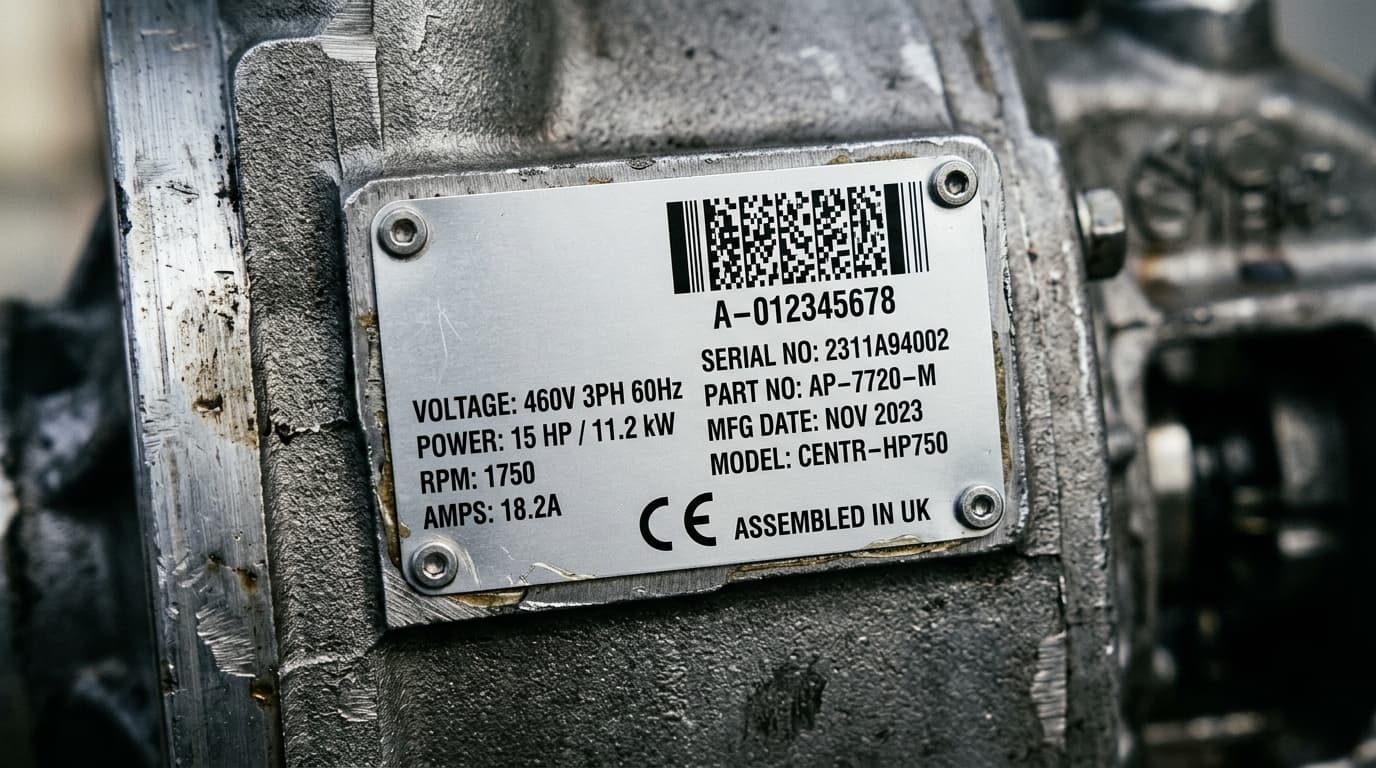
1. Optical Reflectance Physics, Specular Glare & Metallized Vapor Deposition Dynamics
The critical technical distinction between B-423 and B-428 lies in optical physics and surface metallurgy. B-423 provides diffuse reflectance for error-free laser/camera scanning, while B-428 incorporates a sputtered aluminum layer to deliver authentic metallic nameplate durability.
B-423: High-Refractive-Index Titanium Dioxide (TiO2) Diffuse Polyester
B-428: Sputtered Aluminum Vapor-Deposited Metallized Polyester
2. Substrate Peel Adhesion Matrix (ASTM D1000 180° Peel)
Standardized 180° peel adhesion testing across high surface energy (HSE), low surface energy (LSE), and textured powder-coated substrates after 20-minute and 24-hour dwell periods.
| Test Substrate | Surface Energy | B-423 Peel Force | B-428 Peel Force | Outcome |
|---|---|---|---|---|
| Stainless Steel (20-Min Dwell) | >45 dynes/cm (High Energy) | 20-min: 51 oz/in (56 N/100mm) 24-hr: 57 oz/in (62 N/100mm @ 72-hr) | 20-min: 44 oz/in (48 N/100mm) 24-hr: 44 oz/in (48 N/100mm @ 72-hr) | B-423 (+30% higher peel adhesion on steel) |
| Cast & Machined Aluminum Chassis | >42 dynes/cm (High Energy) | 20-min: 48 oz/in (52 N/100mm) 24-hr: 54 oz/in (59 N/100mm) | 20-min: 42 oz/in (46 N/100mm) 24-hr: 45 oz/in (49 N/100mm) | B-428 (Perfect visual aesthetic match on aluminum) |
| Polypropylene (LSE Plastic) | 29–31 dynes/cm (Low Energy) | 20-min: 10 oz/in (11 N/100mm) 24-hr: 33 oz/in (36 N/100mm @ 72-hr) | 20-min: 14 oz/in (15 N/100mm) 24-hr: 28 oz/in (31 N/100mm @ 72-hr) | B-423 (Slightly higher ultimate hold on plastic) |
| Smooth Glass Surfaces | >250 dynes/cm (Ultra-High) | 20-min: 49 oz/in (54 N/100mm) 24-hr: 55 oz/in (60 N/100mm) | 20-min: 40 oz/in (44 N/100mm) 24-hr: 43 oz/in (47 N/100mm) | B-423 (Superior permanent grip on glass) |
| Optical Reflectance Contrast (PCS) | Barcode Readability Metric | 20-min: > 90% Diffuse White Reflectance 24-hr: PCS > 0.85 (Zero glare errors) | 20-min: 50% Specular Metallized Reflectance 24-hr: Requires polarized/diffuse lighting for 2D codes | B-423 (Unsurpassed 2D DataMatrix scanning speed) |
3. Total Cost of Ownership (TCO) & Labor Economics: On-Demand Metallized Rating Decals vs. Riveted Stamped Metal Nameplates
Traditional OEM rating plates require outsourcing stamped/etched aluminum plates, stocking pre-numbered inventory, drilling holes in machine enclosures, and manually riveting plates. Switching to on-demand thermal transfer B-428 or B-423 labels radically slashes manufacturing overhead.
| Economic Dimension | B-423 / B-428 On-Demand Thermal Decals | Outsourced Riveted Aluminum Nameplates |
|---|---|---|
| Unit Plate / Label Material CostOn-demand thermal printing cuts material procurement cost by 97.7%. | $0.08 / label (2.0" x 1.0") | $3.50 / plate (Custom etched metal) |
| Enclosure Machining & Hole Drilling LaborEliminates enclosure machining and preserves IP65/NEMA 4 seal integrity. | $0.00 (Zero drilling required; peel & stick) | $1.50 (1.5 min to CNC drill / tap mounting holes) |
| Riveting & Mechanical Fastening Labor (@ $60/hr)Saves 90% in assembly floor installation time. | $0.10 (6 seconds to peel and apply) | $1.00 (1.0 min to align and pop-rivet plate) |
| Lead Time for Custom Serialized Data / BarcodesEnables dynamic real-time serialization, MAC addresses, and lot tracking. | Instant (Printed on-demand at assembly station) | 2–4 Weeks (Outsourced vendor lead time) |
| Total Cost per 1,000 Machine EnclosuresDirect net savings of $5,820 per 1,000 manufactured machines! | $180 Total ($80 material + $100 labor) | $6,000 Total ($3,500 plates + $2,500 labor) |
4. 15-Point Parametric Specification Diff
Direct ASTM laboratory metrics, operating limits, and physical mechanical properties extracted from verified Brady Technical Data Sheets (TDS).
| Technical Dimension | B-423 (Gloss White Thermal Transfer Polyester) | B-428 (Metallized Matte Silver Thermal Transfer Polyester) | Key Advantage |
|---|---|---|---|
| Substrate Polymer Formulation | White Polyester Film (TiO2 Pigmented) | Metallized Polyester Film (Vapor-Deposited Aluminum) | B-423 (Brilliant White) vs B-428 (Brushed Metallic Silver) |
| Surface Finish & Aesthetic | High-Gloss Brilliant White | Matte Light Gray / Brushed Metallic Aluminum | B-428 (Replicates stamped metal equipment nameplates) |
| Total Construction Caliper (Thickness) | 3.0 mil (0.076 mm) (ASTM D1000) | 4.0 mil (0.102 mm) (ASTM D1000) | B-423 (Low profile 3.0 mil) vs B-428 (Rigid 4.0 mil heavy film) |
| Continuous Service Temperature Range | -40°F to 248°F (-40°C to +120°C) | -40°F to 248°F (-40°C to +120°C) | Tie (Both rated for -40°C to +120°C operating limits) |
| Short-Term High Temperature Peak | 293°F (145°C) for short durations | 320°F (160°C) for short durations (slight discoloration) | B-428 (+15°C higher thermal resistance limit) |
| Peel Adhesion on Stainless Steel (72-hr) | 57 oz/in (62 N/100mm) (ASTM D1000) | 44 oz/in (48 N/100mm) (ASTM D1000) | B-423 (+30% higher peel adhesion on steel) |
| Optical Reflectance Contrast (PCS) | > 90% Diffuse White Reflectance (PCS > 0.85) | 50% Specular Metallized Reflectance | B-423 (Superior 2D DataMatrix and micro-barcode reading) |
| UL 969 Recognized Component | Recognized under File MH17154 (Tested with R6000HF) | Recognized under File MH17154 (Tested with R4300) | Tie (Both UL 969 recognized for rating and serial plates) |
| CSA C22.2 Acceptance | Accepted under CSA File 041833 | Accepted under CSA File 041833 | Tie (Both CSA certified for Canadian electrical products) |
| Recommended Thermal Transfer Ribbon | Brady Series R6000HF Halogen-Free Pure Resin | Brady Series R4300 Wax / Resin Hybrid (or Series R6200) | B-423 uses pure resin for extreme solvent resistance |
| Outdoor Weatherability (ASTM G155 / Xenon Arc) | Passes 30 days Xenon Arc with zero visible degradation | Passes 30 days Xenon Arc with zero visible degradation | Tie (Both resist UV radiation and outdoor weathering) |
| Salt Fog Resistance (ASTM B117 / 30 Days) | No visible effect (30 days in 5% salt spray) | No visible effect (30 days in 5% salt spray) | Tie (Both resist marine and offshore coastal environments) |
| Solvent Immersion (MEK / Toluene) | Resists MEK and aggressive cleaning with R6000HF | Substrate intact; print resists light rubbing with R4300 | B-423 (R6000HF resin provides superior MEK rub hold) |
| Dielectric Breakdown Voltage | 8,500 Volts (ASTM D1000) | Not recommended as primary electrical insulator | B-423 (High dielectric insulation strength) |
| Printer Hardware Compatibility | Portable (M210, M410, M610, M710) & Benchtop (i5100, i7100, i3300) | Portable (M610, M710, BMP71) & Benchtop (i5100, i7100, i3300) | B-423 (Available in all compact portable cartridges) |
5. Chemical Immersion & Harsh Solvent Head-to-Head
Standardized 5-cycle immersion testing (10-minute fluid exposure + 30-minute recovery period per ASTM protocols followed by cotton swab rub tests).
| Chemical Reagent | B-423 Observation | B-428 Observation | Outcome |
|---|---|---|---|
| Methyl Ethyl Ketone (MEK) | Passed (Print intact after 100 double rubs with R6000HF) | Passed (Print legible after rub with R4300; rating 3) | B-423 |
| Toluene & Aromatic Solvents | Passed (No visible effect on substrate or print) | Passed (Substrate intact; print legible with rub) | B-423 |
| Mineral Spirits & Aliphatics | Passed (Dip & Rub: No Visible Effect) | Passed (Dip & Rub: No Visible Effect) | Tie |
| JP-8 Aviation Jet Fuel | Passed (No visible effect after 24-hr immersion) | Passed (No visible effect after 24-hr immersion) | Tie |
| SAE 20 WT Engine Oil @ 70°C | Passed (24-hr immersion: zero effect) | Passed (24-hr immersion: zero effect) | Tie |
| Isopropyl Alcohol (IPA 99%) | Passed (100 double rubs: zero effect) | Passed (100 double rubs: zero effect) | Tie |
| Brake Fluid (DOT 4 Automotive) | Passed (No visible effect on label or print) | Passed (No visible effect on label or print) | Tie |
| Skydrol® 500B-4 Hydraulic Fluid | Passed (Slight edge softening; print intact) | Passed (Slight edge softening; print intact) | Tie |
| 10% Sulfuric Acid Solution | Passed (Dip & Rub: No Visible Effect) | Passed (Dip & Rub: No Visible Effect) | Tie |
| 10% Sodium Hydroxide Solution | Passed (Dip & Rub: No Visible Effect) | Passed (Dip & Rub: No Visible Effect) | Tie |
| Deionized Water (1000 hrs @ 95% R.H.) | Passed (1000 hrs @ 100°F: zero degradation) | Passed (1000 hrs @ 100°F: zero degradation) | Tie |
| Salt Fog Chamber (ASTM B117 / 30 Days) | Passed (30 days 5% salt spray: zero corrosion) | Passed (30 days 5% salt spray: zero corrosion) | Tie |
6. Failure Modes: When to NEVER Use B-423 vs. B-428
Critical engineering boundary limits where material physics fail under extreme environmental, mechanical, or chemical stress.
- Machinery Rating Plates Requiring Traditional Stamped Aluminum OEM Aesthetics: B-423 has a bright glossy white finish that may look like a paper or plastic decal rather than a cast metal rating plate on rugged cast iron or cast aluminum pump bodies.
- Low Surface Energy Textured Powder Coat: Standard B-423 acrylic adhesive will flag or lift from textured 28 dynes/cm powder coat paints (use high-tack B-483A instead).
- Curved Cable or Wire Marking Applications: B-423 is a stiff polyester film with memory; wrapping it around curved wire will cause flagging (use self-laminating B-427 or B-499 cloth).
- High-Speed Automated 2D Barcode Vision Systems with Harsh Lighting: B-428's metallized layer creates specular (mirror-like) light reflections that can blind fixed-mount CCD/CMOS barcode cameras (use B-423 for diffuse >90% reflectance).
- Electrical Dielectric Insulation Barriers: Because B-428 contains a vapor-deposited conductive aluminum metallic layer, it should never be used as an electrical insulating barrier between live circuit board traces or high-voltage terminals.
- Continuous High Heat Exposure Above 248°F (120°C): While B-428 tolerates short peaks up to 320°F (160°C), prolonged exposure causes silver tint discoloration (for 300°C wave solder, specify B-652 polyimide).
7. Hardware Intelligence: Thermal Transfer Ribbon Formulation & Printers
A high-performance rating plate or wire marker is only as durable as the thermal transfer ribbon chemistry paired with it.
Engineering Decision FAQ: B-423 vs. B-428
The primary difference is aesthetic finish and optical reflectance. B-423 is a brilliant gloss white polyester film that delivers maximum diffuse optical reflectance (>90%) for flawless high-density 2D DataMatrix and barcode scanning. B-428 is a metallized matte silver polyester film with a vapor-deposited aluminum layer that replicates the authentic appearance of stamped or brushed aluminum metal nameplates, matching cast metal motor housings and industrial machinery at 97% lower cost than riveted plates.
Automated machine vision cameras and laser scanners rely on diffuse light reflection to distinguish black printed bars/dots from the label background. B-423's high-purity TiO2 white pigment scatters light evenly, achieving a Print Contrast Signal (PCS) above 0.85 without glare. B-428's metallized aluminum surface causes specular (mirror-like) light reflections that can saturate camera sensors and cause read errors unless diffused dome lighting or polarized optical filters are installed.
Traditional riveted metal plates cost $3.50+ each, require 2–4 week vendor lead times, and necessitate drilling mounting holes in equipment enclosures (costing $2.50 in machining and riveting labor while risking enclosure seal leaks). B-428 allows manufacturers to print serialized rating plates on-demand for $0.08 per label, peeling and applying in 6 seconds with permanent 44 oz/in adhesion on steel, saving $5,820 per 1,000 manufactured machines.
Yes! Both B-423 and B-428 are UL 969 Recognized Components under UL File MH17154 and CSA C22.2 accepted under File 041833 for rating and serial plates. Note that UL compliance for B-423 requires printing with Brady Series R6000HF pure resin ribbon, while UL compliance for B-428 requires printing with Brady Series R4300 wax/resin hybrid ribbon.
No. Both B-423 and B-428 feature standard permanent acrylic adhesives designed for smooth, high-energy surfaces (stainless steel, cast aluminum, glass, rigid plastics). On textured powder-coat paint (28 dynes/cm), specify Brady B-483A (ultra-aggressive 160 oz/in peel) or B-486B (ultra-aggressive high-tack metallized matte silver polyester).
Both materials are rated for continuous service from -40°F to 248°F (-40°C to +120°C). B-428 has slightly higher short-term peak tolerance up to 320°F (160°C) with minor silver tint discoloration, making it suitable for hot industrial motor housings and gearbox exteriors.
No. Because B-428 contains a continuous vapor-deposited layer of elemental aluminum, it has low surface resistivity and should never be used as a primary dielectric or insulating barrier between electrical contacts or PCB traces (use B-423, which has an 8,500V dielectric breakdown rating).