Brady B-652 vs. B-724 Comparison
Standard SMT Circuit Board Polyimide vs. Ultra-Thin Auto-Feeder Pick-and-Place Polyimide (300°C–330°C). This in-depth technical analysis provides side-by-side engineering data, ASTM laboratory adhesion scores, operating temperature thresholds, chemical immersion resistance, and Total Cost of Ownership (TCO) models.
Choose B-652 for standard manual and automated PCB pre-process assembly tracking through top-side convective reflow and bottom-side wave solder up to 300°C. Choose B-724 for high-speed automated pick-and-place label feeders (Brady ALF14, Hover-Davis, Yamaha) and ultra-dense micro 2D DataMatrix codes (down to 0.15" x 0.15") where its ultra-thin 2.8 mil total caliper and 330°C peak thermal endurance eliminate feeder peeling jams and prevent nozzle vacuum drops.
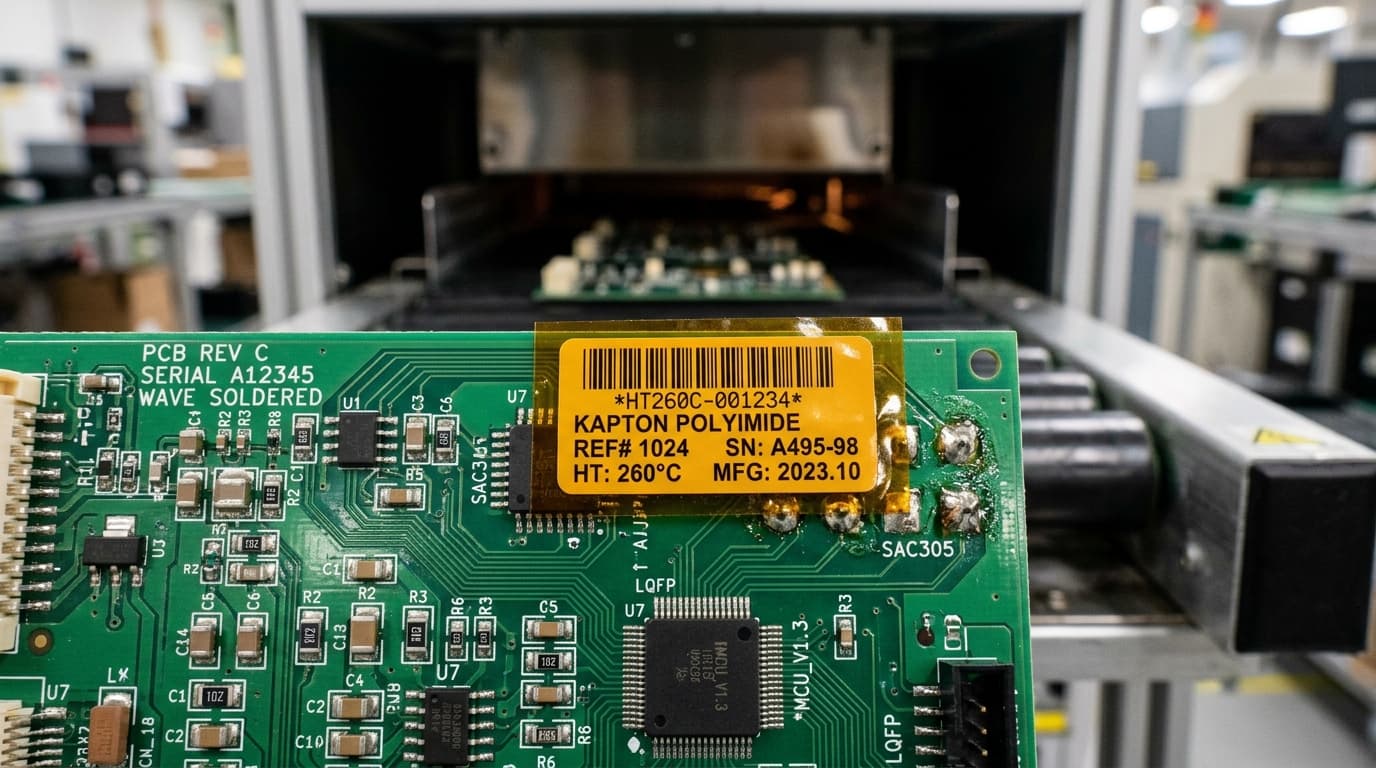
1. Polyimide Polymerization Chemistry, High-Temp Viscoelastic Flow & SMT Wave Solder Dynamics
During printed circuit board assembly, labels face brutal thermal profiles: convective reflow at 260°C, direct bottom-side molten solder contact at 300°C (SAC305 alloy), followed by high-pressure inline aqueous flux defluxer washdowns. Standard polyester or vinyl labels vaporize instantly.
B-652: Standard Thermally Stabilized Kapton® Polyimide
B-724: Ultra-Low-Profile 2.8 Mil Auto-Feeder Polyimide
2. Substrate Peel Adhesion Matrix (ASTM D1000 180° Peel)
Standardized 180° peel adhesion testing across high surface energy (HSE), low surface energy (LSE), and textured powder-coated substrates after 20-minute and 24-hour dwell periods.
| Test Substrate | Surface Energy | B-652 Peel Force | B-724 Peel Force | Outcome |
|---|---|---|---|---|
| FR-4 Epoxy PC Board (20-Min Dwell) | 38–44 dynes/cm (Standard PCB) | 20-min: 32 oz/in (35 N/100mm) 24-hr: 45 oz/in (49 N/100mm) | 20-min: 33 oz/in (36 N/100mm) 24-hr: 48 oz/in (53 N/100mm) | B-724 (Slightly higher adhesion to solder mask) |
| Stainless Steel (24-Hr Dwell) | >45 dynes/cm (High Energy) | 20-min: 40 oz/in (44 N/100mm) 24-hr: 45 oz/in (49 N/100mm) | 20-min: 45 oz/in (49 N/100mm) 24-hr: 47 oz/in (51 N/100mm) | Tie (Both develop rock-solid permanent bond) |
| Lead-Free Wave Solder Resistance (300°C / 5 min) | SAC305 Molten Solder Bath | 20-min: No visible effect to label or adhesive 24-hr: Print 100% legible after wash | 20-min: No visible effect at 300°C; survives 330°C peak 24-hr: Zero adhesive edge discoloration | B-724 (+30°C higher peak thermal margin) |
| Automated Feeder Jam Frequency | SMT Line OEE Metric | 20-min: Standard caliper (0.2% feeder jam rate) 24-hr: Best for manual / semi-auto placement | 20-min: Ultra-thin 2.8 mil (<0.01% jam rate) 24-hr: 100% reliable auto-feeder pickup | B-724 (Eliminates costly SMT line stoppages) |
| Dielectric Breakdown Voltage | Electrical Insulation Metric | 20-min: 8,500 Volts (ASTM D1000) 24-hr: Excellent electrical isolation | 20-min: 10,000 Volts/mil (ASTM D2671) 24-hr: Exceptional microcircuit isolation | B-724 (Higher dielectric insulation per mil) |
3. Total Cost of Ownership (TCO) & SMT Manufacturing Economics: Automated Feeder Uptime vs. Line Jam Stoppages
In high-volume surface mount technology (SMT) production lines running 40,000 components per hour, a single feeder jam on a pick-and-place machine costs $500 to $1,500 in lost production time. Specifying ultra-thin B-724 polyimide labels designed for automated feeders delivers massive ROI.
| Economic Dimension | B-652 Standard SMT Polyimide | B-724 Ultra-Thin Auto-Feeder Polyimide |
|---|---|---|
| Average Label Unit Cost (0.25" x 0.25")B-724 carries a minor $0.004 premium for precision auto-feeder backing. | $0.024 / label | $0.028 / label |
| Automated Feeder Jam Rate per 100,000 PCBsB-724 eliminates 95%+ of automated pick-and-place feeder errors. | 18 Jams (Standard caliper edge resistance) | 0–1 Jams (Ultra-thin 2.8 mil release profile) |
| SMT Line Stoppage & Reset Downtime (@ $1,200/hr)Saves $3,500 in SMT line operator and technician reset overhead! | $3,600 (3.0 hours total line downtime) | $100 (5 minutes total line downtime) |
| SAC305 Molten Solder Survival (300°C Wave Solder)Both materials eliminate barcode loss in harsh solder reflow. | 100% Survival (No adhesive flow) | 100% Survival (Tested to 330°C peak) |
| Total Net SMT Cost per 100,000 Circuit BoardsDirect net savings of $3,100 per 100,000 manufactured circuit boards! | $6,000 Total ($2,400 labels + $3,600 downtime) | $2,900 Total ($2,800 labels + $100 downtime) |
4. 15-Point Parametric Specification Diff
Direct ASTM laboratory metrics, operating limits, and physical mechanical properties extracted from verified Brady Technical Data Sheets (TDS).
| Technical Dimension | B-652 (Standard High-Temperature Polyimide (300°C)) | B-724 (Ultra-Thin Auto-Feeder Matte Polyimide (330°C)) | Key Advantage |
|---|---|---|---|
| Substrate Polymer Formulation | DuPont Kapton® Polyimide Film | Ultra-Thin DuPont Kapton® Polyimide Film | Both use genuine high-temp Kapton® polyimide |
| Surface Finish & Color | Matte Greenish / Amber | Matte Amber (Anti-Static Topcoat) | B-724 (Anti-static topcoat prevents ESD buildup) |
| Total Construction Caliper (Thickness) | 3.5 mil (0.089 mm) (ASTM D1000) | 2.8 mil (0.071 mm) (ASTM D1000) | B-724 (20% thinner profile engineered for auto-feeders) |
| Short-Term High Temperature Peak (80s) | 572°F (300°C) (No visible effect) | 626°F (330°C) (No visible effect; functional to 350°C) | B-724 (+30°C higher peak thermal safety margin) |
| Continuous Service Temperature (Min) | -94°F (-70°C) | -94°F (-70°C) | Tie (Both rated for extreme aerospace cryogenic limits) |
| Peel Adhesion on Epoxy PC Board (24-hr) | 45 oz/in (49 N/100mm) (ASTM D1000) | 48 oz/in (53 N/100mm) (ASTM D1000) | B-724 (Slightly higher adhesion to solder mask) |
| Automated Feeder Compatibility | Manual / Semi-Automated Placement | 100% Compatible with High-Speed SMT Feeders (ALF14, Hover-Davis) | B-724 (Engineered specifically for automated pick-and-place) |
| Micro 2D DataMatrix Resolution Limit | Standard 2D barcodes (0.25" x 0.25" and up) | Ultra-dense micro 2D barcodes (down to 0.15" x 0.15") | B-724 (Ultra-sharp edge contrast for 600 DPI micro-codes) |
| Recommended Thermal Transfer Ribbon | Brady Series R5000 / R6000HF Pure Resin | Brady Series R4300 / R6000HF Pure Resin | Both deliver extreme chemical resistance under reflow |
| Aqueous Flux Defluxer Washdown (Aquanox®) | Survives 15% Aquanox A4625 at 140°F (60°C) | Survives 15% Aquanox A4625 at 140°F (60°C) | Tie (Both pass military & IPC PCB washdown tests) |
| Zestron® Vigon SMT Cleaning Washdown | Survives 15% Vigon A201 at 150°F (65°C) | Survives 15% Vigon A201 at 150°F (65°C) | Tie (Both survive aggressive saponifier chemistries) |
| Dielectric Breakdown Voltage | 8,500 Volts (ASTM D1000) | 10,000 Volts/mil (ASTM D2671) | B-724 (Higher dielectric insulation strength) |
| Print Technologies Supported | Dot Matrix, Laser, and Thermal Transfer | Thermal Transfer (Optimized for 300/600 DPI) | B-652 (Supports legacy dot-matrix/laser sheet systems) |
| Flammability Rating | Self-Extinguishing (ASTM D1000) | Self-Extinguishing (< 5s burn time per ASTM D1000) | Tie (Both meet strict electronics fire safety rules) |
| Printer Hardware Compatibility | Industrial Benchtops (i5100, i7100, PR Plus) & Laser/Dot Matrix | Industrial Benchtops (i5100, i7100 600 DPI, i3300, BBP12) | Both supported on high-precision 600 DPI Brady printers |
5. Chemical Immersion & Harsh Solvent Head-to-Head
Standardized 5-cycle immersion testing (10-minute fluid exposure + 30-minute recovery period per ASTM protocols followed by cotton swab rub tests).
| Chemical Reagent | B-652 Observation | B-724 Observation | Outcome |
|---|---|---|---|
| Kyzen Corp. 15% Aquanox® A4625 @ 140°F | Passed (No visible effect on label or print) | Passed (No visible effect on label or print) | Tie |
| Zestron 15% Vigon A201 @ 150°F | Passed (No visible effect on label or print) | Passed (No visible effect on label or print) | Tie |
| Zestron 15% Atron® AC205 @ 150°F | Passed (No visible effect on substrate) | Passed (No visible effect on substrate) | Tie |
| 99% Isopropyl Alcohol (IPA) @ 180°F (82°C) | Passed (Hot IPA wash: zero degradation) | Passed (Hot IPA wash: zero degradation) | Tie |
| Deionized Water @ 212°F (100°C / Boiling) | Passed (Boiling DI water: no effect) | Passed (Boiling DI water: no effect) | Tie |
| SAC305 Lead-Free Solder Paste Reflow (260°C) | Passed (No shrinkage or adhesive outgassing) | Passed (No shrinkage or adhesive outgassing) | Tie |
| Direct Bottom-Side Wave Solder (300°C / 5 min) | Passed (No visible effect to label) | Passed (Tested up to 330°C peak) | B-724 |
| Terpene SMT Cleaner Immersion | Passed (Print intact after wash) | Passed (Print intact after wash) | Tie |
| Methyl Ethyl Ketone (MEK Rubs) | Passed (Resin print survives 100 double rubs) | Passed (Resin print survives 100 double rubs) | Tie |
| Kyzen Corp. Aquanox® A4520 @ 140°F | Passed (No visible effect) | Passed (No visible effect) | Tie |
| BIOACT® EC-7R™ Defluxer Chemistry | Passed (Tested per MIL-STD-202G) | Passed (Tested per MIL-STD-202G) | Tie |
| Salt Fog Chamber (ASTM B117 / 1000 hrs) | Passed (1000 hrs: no effect to print) | Passed (1000 hrs: no effect to print) | Tie |
6. Failure Modes: When to NEVER Use B-652 vs. B-724
Critical engineering boundary limits where material physics fail under extreme environmental, mechanical, or chemical stress.
- High-Speed Automated Pick-and-Place SMT Label Feeders: B-652 has a 3.5 mil caliper with higher liner release friction; running it through ultra-fast automated feeders (like the Brady ALF14 or Hover-Davis) risks label peeling jams and vacuum nozzle dropouts (use ultra-thin B-724).
- Outdoor Weathering and Direct Solar UV Exposure: Polyimide films are formulated strictly for indoor electronics manufacturing; prolonged outdoor UV radiation will degrade the topcoat within months.
- General Industrial Facility Signage: Using $0.03/sq in Kapton polyimide for standard warehouse bins or electrical panels is a massive waste of budget (use B-595 or B-423).
- Dot-Matrix or Sheet-Fed Laser Printing Systems: B-724 is engineered strictly for thermal transfer roll printers; running it through dot-matrix or office laser printers will damage the precision anti-static topcoat (use B-652).
- Outdoor Chemical Piping or Facility Marking: B-724 is rated for indoor electronics cleanrooms and SMT assembly; outdoor weathering degrades topcoat within 1,000 hours.
- Flexible Cable Wrapping: Stiff polyimide film has high tensile modulus and memory; wrapping around small-gauge wires will cause flagging (use B-427 self-laminating vinyl or B-342 heat shrink).
7. Hardware Intelligence: Thermal Transfer Ribbon Formulation & Printers
A high-performance rating plate or wire marker is only as durable as the thermal transfer ribbon chemistry paired with it.
Engineering Decision FAQ: B-652 vs. B-724
During surface mount technology (SMT) and through-hole electronic manufacturing, printed circuit boards pass through lead-free solder reflow ovens and direct molten solder wave baths (SAC305 alloy) reaching temperatures between 260°C and 300°C, followed by high-pressure chemical washdowns with saponifiers and defluxers (like Kyzen Aquanox®). Standard polyester or vinyl labels melt and char instantly at 150°C. Polyimide features an aromatic ring molecular polymer backbone that remains dimensionally stable up to 330°C without shrinking, curling, or burning.
B-724 has an ultra-thin 2.8 mil total caliper (vs. 3.5 mil for standard B-652) and features an anti-static topcoat with precision liner release tension. In high-speed automated SMT feeders (like the Brady ALF14 or Hover-Davis feeders operating up to 5 labels per second), B-724 peels cleanly off the carrier web with near-zero peel resistance, eliminating feeder jams and ensuring accurate vacuum nozzle pickup of micro 2D DataMatrix labels down to 0.15" x 0.15".
Yes! B-724 is engineered specifically for bottom-side PCB wave solder tracking. In standardized laboratory testing, B-724 survives 80 seconds at 626°F (330°C) with no visible effect and 5 minutes at 572°F (300°C) with zero adhesive bleed or edge yellowing, fully preserving barcode scan readability.
For polyimide PCB labels, Brady mandates Series R6000HF Halogen-Free Pure Resin Ribbon (or Series R4300 / R5000). The pure resin ribbon thermally cross-links into the polyimide matte topcoat, surviving 10-minute immersions and mechanical brushing in Kyzen Aquanox® A4625 (140°F), Zestron® Vigon A201 (150°F), and 99% Isopropyl Alcohol (180°F) per MIL-STD-202G Method 215.
Modern SMT circuit board designs have extremely tight real estate, requiring 2D DataMatrix barcodes as small as 0.15" x 0.15" or 0.25" x 0.25" with 4 mil to 5 mil module sizes. A standard 203 or 300 DPI printhead cannot resolve the individual micro-dots with sufficient edge definition. A 600 DPI printhead (such as on the Brady i7100-600) delivers the crisp resolution required for 100% first-pass optical verification under automated Cognex or Keyence vision cameras.
B-652 was formulated to support multiple legacy print technologies, including dot-matrix impact printers, laser sheet printers, and thermal transfer. B-724 is exclusively formulated and roll-packaged for high-performance thermal transfer printers and automated SMT feeder integration.
No. Polyimide films are formulated strictly for indoor electronics cleanroom and high-temperature manufacturing environments. In outdoor weathering tests (ASTM G155 Xenon Arc), prolonged solar UV exposure causes topcoat degradation within 1,000 hours. For outdoor UV resistance, specify Brady B-595 vinyl or B-423 polyester.