Equipment Nameplate Design: A 20-Year Document at Label Scale
A nameplate is the one document guaranteed to still be with the machine in twenty years — after the manual is lost, the OEM is acquired, and the maintenance system has been migrated twice. Design it like that is its job: stable fields only, ruthless hierarchy, machine-readable identity, and a material rated for the machine's environment rather than the office it was specified in.
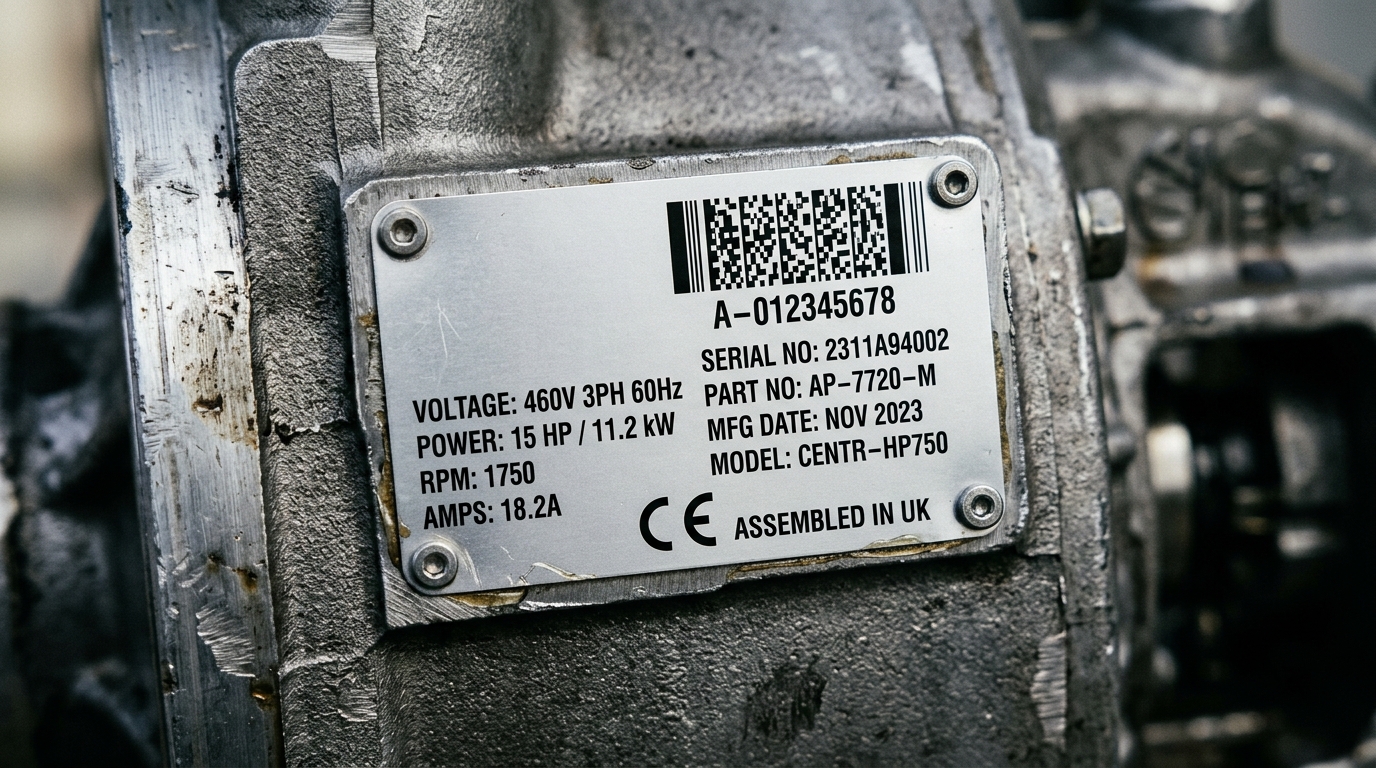
1. The Field Checklist
The discipline is what you leave off: a nameplate carries only facts true for the machine's whole life. Everything mutable — options, firmware, inspection status — lives on secondary labels that can be replaced without touching the identity plate.
| Field | Why It Earns Plate Space |
|---|---|
| Manufacturer & contact | The service call starts here; make it findable |
| Model & serial number | The identity pair — serial in the same position on every plate, always |
| Ratings (V / Ø / Hz / FLA / SCCR / pressure) | What the equipment class and code require — see NEC 409 for panels |
| Date of manufacture | Warranty math and recall scoping |
| Listing & compliance marks | Only marks that actually apply — inspectors check |
| QR / Data Matrix serial | One scan to the asset record; graded per the barcode guide |
2. The Nameplate Material Tier
The default rating plate: maximum contrast, listing-friendly, resin-printable serials.
The etched-metal aesthetic without etching — brushed silver face, print-on-demand.
Outdoor equipment: compressors, gensets, rooftop units.
When the enclosure is textured powder coat — the adhesion answer from the powder coat guide.
The whole advantage of printed nameplates over etched stock is that the serial, the QR code, and the date print as variable data in the same pass — from the production system, at the moment the unit exists. A beautiful pre-printed plate with a handwritten serial throws that away and fails the 20-year legibility test on day one.
Make the QR half of the plate scan for 20 years too
The barcode engineering guide covers module sizing against printer DPI, quiet zones, and the matte-vs-gloss optics that decide long-term scan rates.