Vinyl vs. Polyester vs. Polyimide vs. Nylon: Picking the Face Stock
Six hundred material families reduce to four polymers plus edge cases, and the right one falls out of three questions asked in order: what surface, what temperature, what chemistry? Answer those honestly and the catalog narrows itself from 603 families to two or three candidates. This guide gives you the family-level map with real TDS service ranges — the fast version of a materials engineer's intuition.
1. Ask the Three Questions in Order
What surface — and does it curve?
Curves and wraps demand conformable stock (vinyl, nylon cloth). Flat metal takes anything. Powder coat and low-energy plastics change the adhesive answer before the face stock answer — see the surface problem-solver portals.
What temperature — peak, not average?
Rate for the worst hour of the label's life: the autoclave cycle, the reflow oven, the engine compartment in August. Vinyl dies near 80°C, polyester at 110–160°C, polyimide at 330°C.
What chemistry touches it?
Wipe-down solvents, cutting oils, battery acid, DMSO. Face stock and ribbon fail together or survive together — verify the pairing in the chemical resistance database.
2. The Four Families, With Real Service Ranges
Flexible, stretchable, happy on curves and rivets. The ceiling is thermal: vinyl families top out near 80°C, so it never belongs near heat.
Dimensionally stable, solvent-tolerant, and the family where most UL 969 recognitions live. The default for anything flat and permanent.
The Kapton class. Costs multiples of polyester and is worth every cent exactly once: when the label rides through a solder process or lives on hot equipment.
A polyamide-coated fabric that stays pressed where you put it. The fix for labels that pop off tight radii — and a favorite in labs for vial curves.
3. The Edge-Case Stocks Worth Knowing
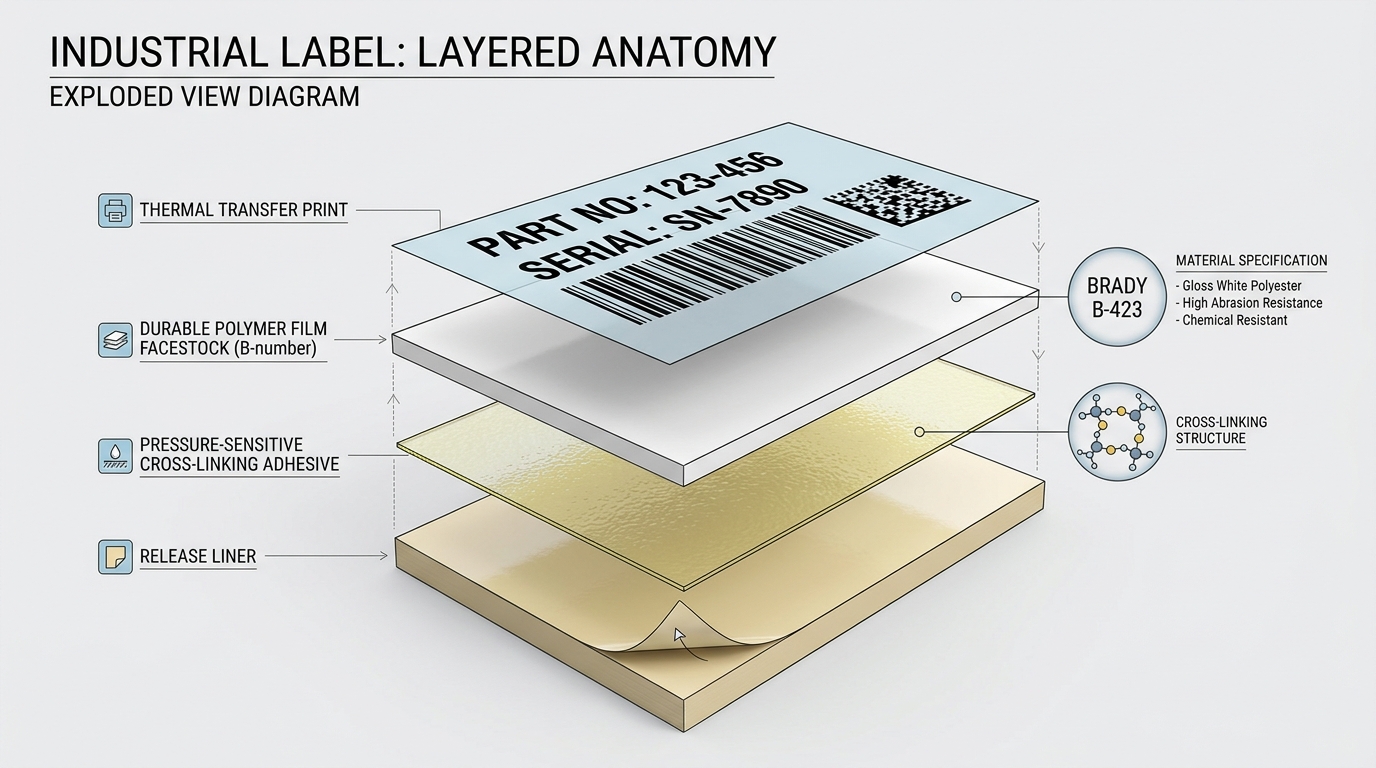
B-595 is superb facility vinyl and carries no UL 969 recognition — it was never meant to be a rating plate. When a nameplate application drifts onto signage stock because "the roll was already in the printer," the label survives but the certification story does not. Nameplates belong on recognized polyester (B-423 class) — see the UL 969 guide for why the recognition travels with material + ribbon.
Have a competitor part number instead of a material spec?
The Cross-Reference Finder maps Panduit, 3M, and TE/Raychem part numbers to the equivalent Brady material family — then this guide tells you if that family is even right for the job.