Histology & Lab Vial Labeling: Surviving the Process Gauntlet
A specimen label has one job description in a pathology lab: come out of every bath the specimen goes into, still legible. That gauntlet — formalin, graded alcohols, xylene, stains, then years of cold storage — destroys office labeling instantly, and a lost specimen identity is not an inconvenience, it is a patient-safety event. Here is the process mapped against the failure points, and the materials rated for each leg.
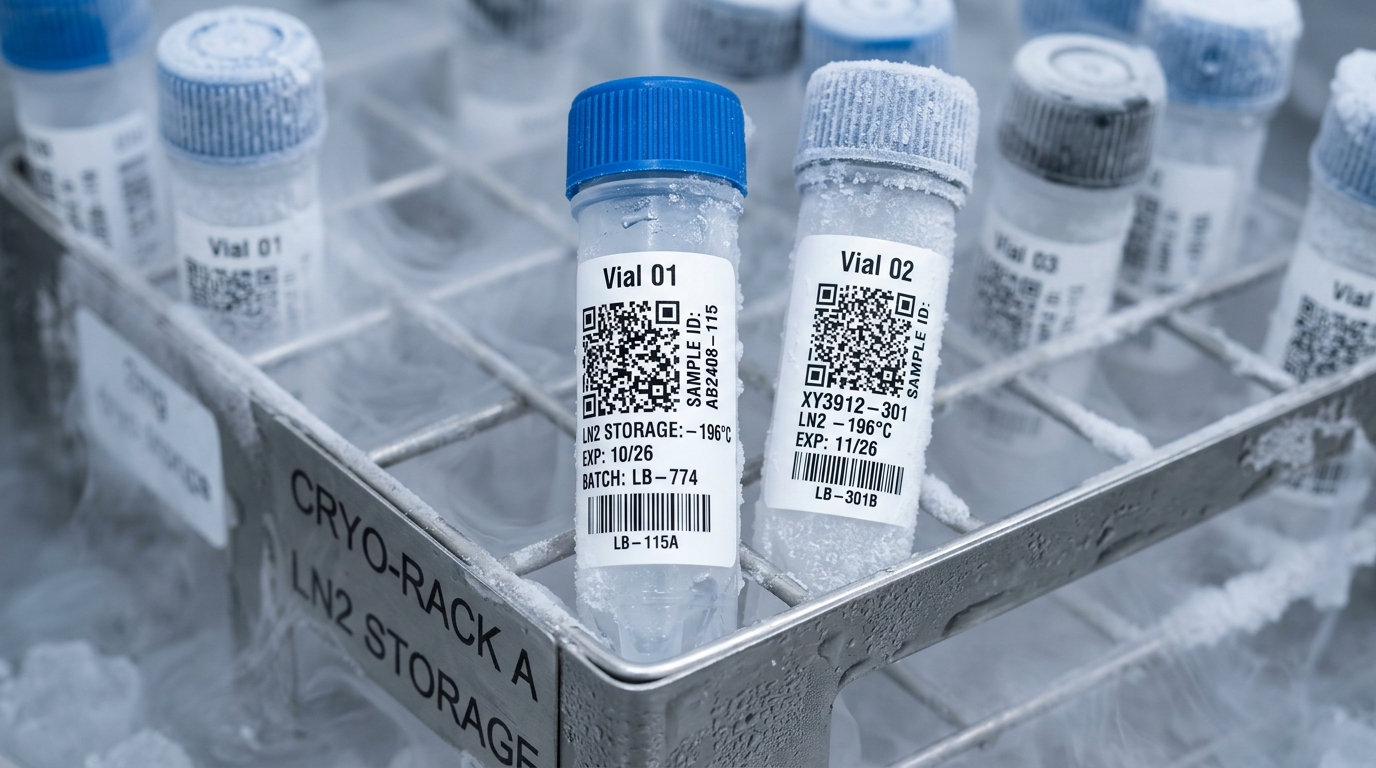
1. The Process Gauntlet, Stage by Stage
Map your own workflow against this table — the label spec is set by the harshest stage it passes, not the average:
| Stage | Chemical / Physical Attack | What It Kills |
|---|---|---|
| Fixation (formalin) | Aqueous aldehyde soak, hours to days | Paper stocks, water-soluble inks |
| Alcohol gradient (70→100% EtOH) | Progressive dehydration baths | Dye-based inkjet legends, weak topcoats |
| Clearing (xylene) | Aggressive aromatic solvent immersion | Laser toner (lifts), most adhesives, vinyl films |
| Staining (H&E and specials) | Sequential chemical baths + rinses | Unprotected print, marginal adhesion |
| Cold storage (-20°C to -196°C) | Adhesive stiffening, frost interface | Everything not freezer-rated — see FreezerBondz |
2. The Lab Material Bench
Slides and general lab ID — the self-wrapping clear tail seals the legend like a lab-scale self-lam.
Cassette faces through the full processor cycle — the purpose-built histology answer.
Tubes and containers with heavy solvent contact.
The workhorse lab PP for tubes, plates, and general containers.
Applies to frozen surfaces; spans freezer to autoclave in one stock.
Every material above assumes thermal transfer with the TDS-matched resin ribbon. A xylene-rated face stock printed on the office laser is a blank xylene-rated face stock by the end of clearing — verify the pairing in the Ribbon Finder and the reagent behavior in the chemical resistance database.
The cold end of the lab story
The cryogenic guide covers -196°C liquid nitrogen storage, frozen-surface application, and the FreezerBondz adhesive engineering in depth.