Overlaminate vs. Topcoat vs. Self-Lam: Three Ways to Protect the Legend
A label that stays stuck but goes blank has still failed — and print protection is its own engineering axis, separate from film and adhesive. The catalog answers it three ways: bond the ink into the film (topcoat), armor the face (overlaminate), or wrap the legend in its own clear film (self-lam). Each defends against different attacks; picking by attack is the whole skill.
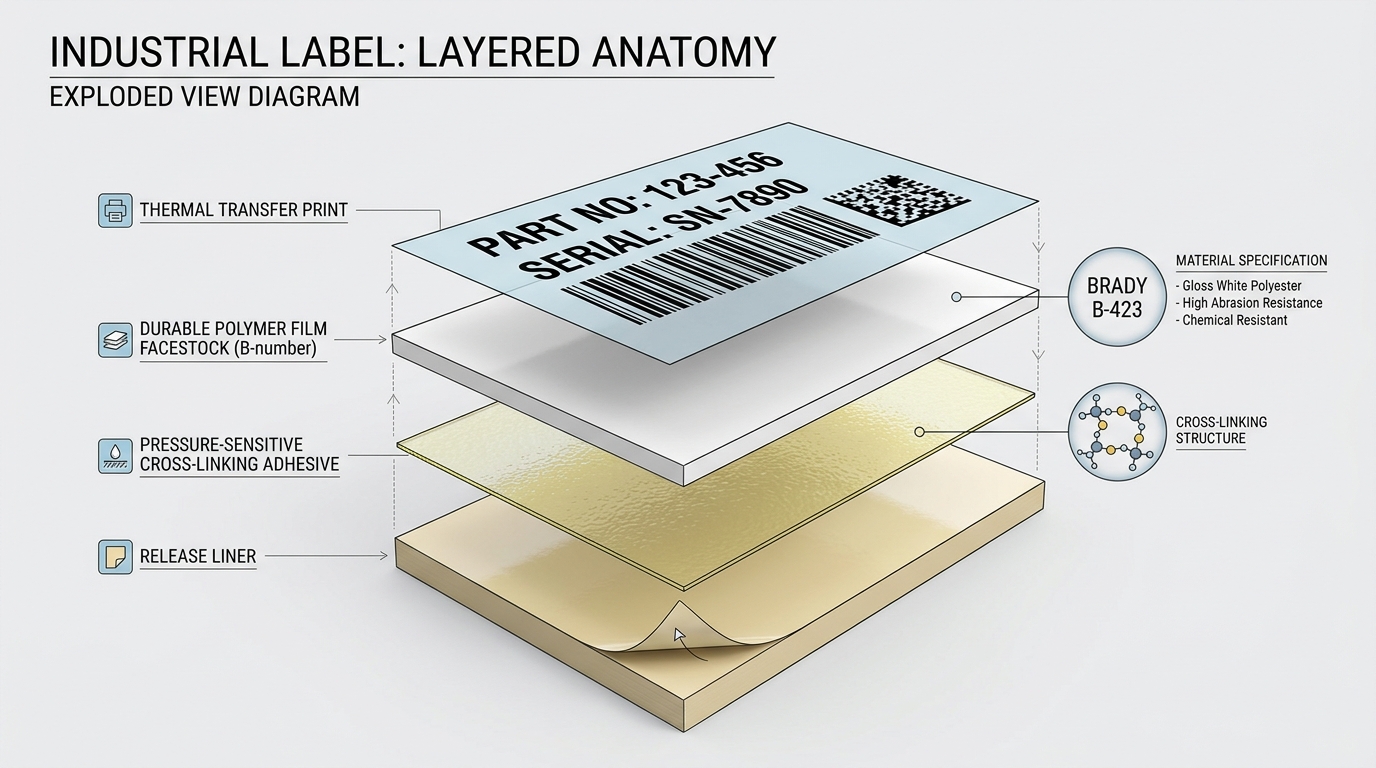
1. The Three Architectures
2. Decision Shortcuts
- Wiped but not rubbed (nameplates, panel labels, container IDs): topcoated stock + resin ribbon. Done — this is most of industrial labeling.
- Rubbed, scrubbed, or walked on (floor marking, handled tags, wash-down instructions): overlaminated construction — B-514 floor graphics and B-920 placards build it in.
- Outdoor for years: overlaminate extends legend life beyond what resin alone holds — the decay sequence is in the outdoor durability guide.
- Cylindrical (wire, cable, tube, vial): self-laminating — B-427 for wire, B-461 for lab glass; geometry per the AWG chart.
- Barcode-critical faces: laminate gloss can add scanner glare — matte overlaminates or matte topcoated stock keep grading honest per the barcode guide.
A wax print under laminate is still a wax print — heat and time attack it from within the sandwich, and laminate edges admit chemistry eventually. Protection layers stack on top of a correct ribbon pairing, never instead of one. Pairing first (Ribbon Finder), armor second.
The layer under all three: the face stock
The material selection guide picks the film these protection layers ride on — vinyl, polyester, polyimide, nylon, by surface, temperature, and chemistry.