Scheme for the Identification of Piping Systems (Color Codes, Sizing & Flow Arrows)
The national standard for identifying piping contents, hazards, and flow directions in industrial, commercial, and institutional facilities. Specifies exact color classifications, legend wording, flow arrow placement, and marker/letter height scaling based on pipe outer diameter.
Pipe markers must withstand continuous pipe operating temperatures (from -40°C to 110°C), atmospheric humidity, chemical washdowns, and UV solar degradation for a minimum of 5 to 8 years without loss of legibility or color fading per ASTM G155 xenon arc testing.
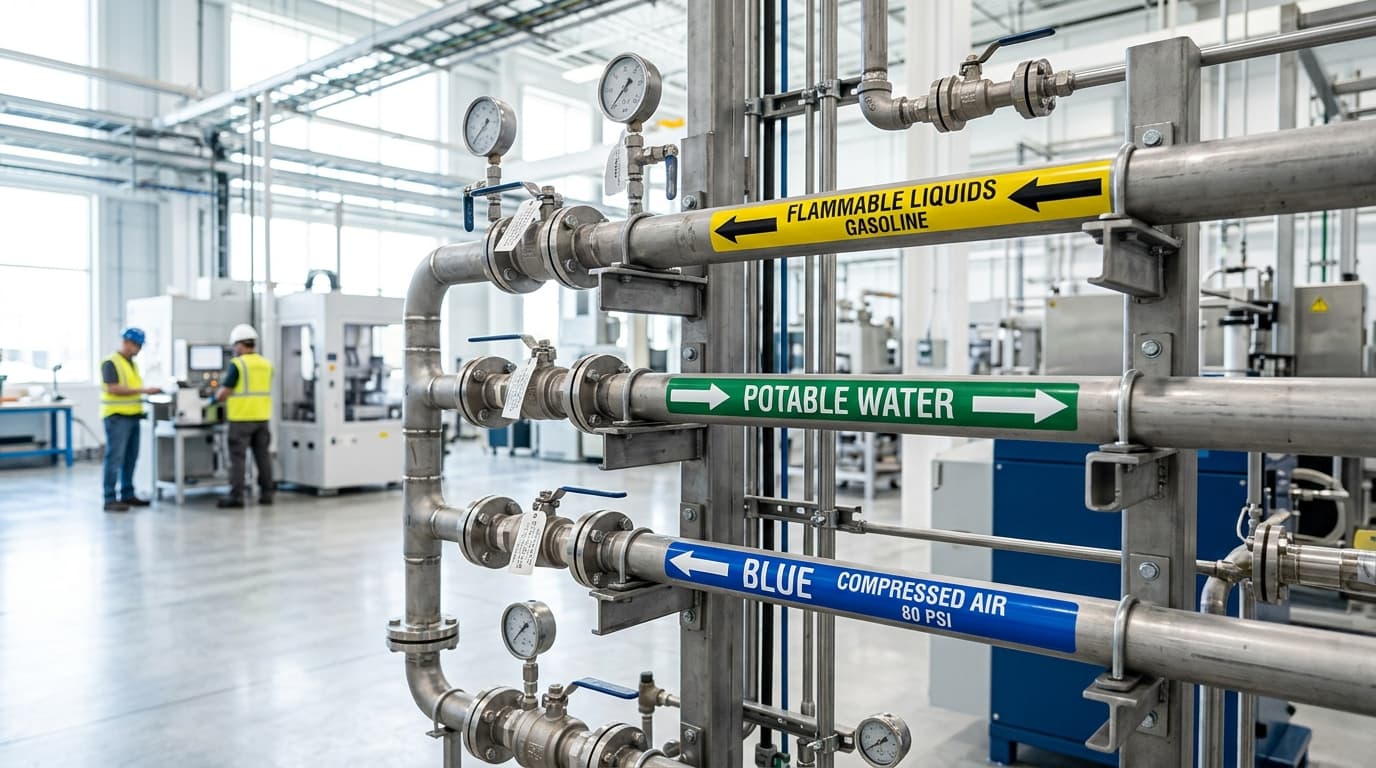
ASME A13.1 (USA) vs. ISO 20560 (International) Piping Standards
ASME A13.1-2023 utilizes full-wrap color-coded background labels with contrasting text across 6 primary fluid hazard categories. In contrast, ISO 20560 (the global marine and international facility standard) uses dual-band color rings combined with GHS diamond pictograms and specific fluid name text blocks.
ASME A13.1-2023 Pre-Audit Inspector Verification Checklist
Review these 5 critical inspection points before the Authority Having Jurisdiction (AHJ) or field auditor inspects the installation:
Mandatory Color Code Assignment
Confirm fluids match ASME Table 1: Yellow/Black (Flammable), Green/White (Potable/Cooling Water), Blue/White (Compressed Air), Red/White (Fire Quenching), Orange/Black (Toxic/Corrosive), Brown/White (Combustible).
Pipe OD vs. Minimum Letter Height
Verify text size meets ASME Table 2: 0.75"–1.25" OD requires ≥0.5" text; 1.5"–2.0" OD requires ≥0.75" text; 2.5"–6.0" OD requires ≥1.25" text; 8.0"–10.0" OD requires ≥2.5" text; >10" OD requires ≥3.5" text.
Flow Directional Arrows
Ensure chevron flow arrows point in the exact direction of fluid flow adjacent to the marker. Two-way arrows required for reversible lines.
Required Placement Frequency
Verify markers are placed: adjacent to all valves and flanges; at change of direction elbows; on both sides of wall/floor penetrations; and at intervals not exceeding 25–50 ft along straight runs.
Material Environmental Longevity
Inspect vinyl against pipe sweating, steam condensation, and UV fading (Brady B-595 cast vinyl with R10000 resin ribbon).
ASME A13.1-2023 Certified Material Substrate Adhesion Matrix (ASTM D1000)
| Material Code | Stainless Steel (HSE) | Textured Powder Coat (28 dynes) | Cast Aluminum | Polypropylene (LSE) | Engineering Verdict |
|---|---|---|---|---|---|
| Brady B-595 | 80 oz/in | 70 oz/in | 75 oz/in | 55 oz/in | Cast vinyl conforming over curved insulated & sweating pipes |
| Brady B-569 | 60 oz/in | 50 oz/in | 55 oz/in | 40 oz/in | Low-halide polyester for stainless steel piping in nuclear/cleanrooms |
| Brady B-946 | 75 oz/in | 65 oz/in | 70 oz/in | 50 oz/in | Self-sticking vinyl marker cards with directional arrows |
Key ASME A13.1-2023 Regulatory Clauses & Mandatory Specifications
| Clause / Section | Regulatory Requirement | Technical Compliance Mandate | Certified B-Numbers |
|---|---|---|---|
| Table 1 | Mandatory Primary Color Designations | Defines 6 mandatory primary color combinations: Yellow/Black (Flammable), Green/White (Water), Blue/White (Compressed Air), Red/White (Fire Quenching), Orange/Black (Toxic/Corrosive), Brown/White (Combustible). | |
| Table 2 | Pipe Diameter vs. Minimum Letter Height | Specifies minimum text height: 0.75"–1.25" OD (≥0.5" text), 1.5"–2.0" OD (≥0.75" text), 2.5"–6.0" OD (≥1.25" text), 8.0"–10.0" OD (≥2.5" text), >10" OD (≥3.5" text). | |
| Section 4.3 | Flow Directional Arrow Placement | Markers must include directional arrows pointing in the direction of fluid flow adjacent to the legend. Reversible lines require two-way arrows. | |
| Section 5.1 | Marker Installation Frequency Rules | Must be installed adjacent to valves/flanges, at change-of-direction elbows, at wall/floor penetrations, and every 25–50 ft along straight pipe runs. |
Certified Brady Materials & Mandated Ribbon Formulations
Brady Series R10000 Premium Outdoor Resin Ribbon
Brady Series R6000HF Pure Resin Ribbon
Factory Inked / Series R10000
Orderable Commercial SKUs & Distributor Part Numbers
Build & Size Your ASME A13.1-2023 Conductor Schedule
Import AutoCAD Electrical wire from/to reports, apply 10% scrap safety factors, and calculate exact roll quantities with 1 click.
ASME A13.1-2023 Frequently Asked Compliance Questions
What are the 6 primary ASME A13.1-2023 pipe marker colors?
The 6 primary colors are: (1) Yellow background with Black text for Flammable/Oxidizing fluids; (2) Green background with White text for Potable/Cooling Water; (3) Blue background with White text for Compressed Air; (4) Red background with White text for Fire Quenching fluids; (5) Orange background with Black text for Toxic/Corrosive fluids; and (6) Brown background with White text for Combustible fluids.
How do I calculate the correct letter height for a pipe marker?
Measure the pipe's outside diameter (OD) including insulation: 0.75" to 1.25" OD requires 0.5" letter height (8" marker length); 1.5" to 2.0" OD requires 0.75" letter height (8" length); 2.5" to 6.0" OD requires 1.25" letter height (12" length); 8.0" to 10.0" OD requires 2.5" letter height (24" length); and pipes over 10.0" OD require 3.5" letter height (32" length).
Can I use standard vinyl tape on stainless steel pipes in cleanrooms?
No. Standard vinyl tapes can contain trace chlorides and sulfur that cause stress corrosion cracking on stainless steel. You should specify Brady B-569 low-halide polyester with R6000HF ribbon, which complies with nuclear and cleanroom low-halogen standards.
Where are pipe markers required to be placed under OSHA 1910.1200?
Pipe markers must be positioned where they are visible from normal operating sightlines: adjacent to all valves and branch fittings, at change-of-direction 90° elbows, on both sides of wall and floor penetrations, and every 25 to 50 feet along continuous straight pipe runs.