Standard for Marking & Labeling Systems (PGDQ2 Finished vs. PGJI2 Printing Materials)
The definitive North American product safety standard governing permanent identification labels, serial rating plates, electrical rating decals, and safety hazard warnings. Establishes the legal testing protocols required for labels to achieve UL Recognized Component status under Category Code Numbers (CCN) PGDQ2 and PGJI2.
Label test samples undergo a 72-hour adhesive cure at 23°C/50% RH followed by severe environmental stress: (1) Thermal aging for 10 to 30 days at elevated temperatures up to 150°C; (2) Cold exposure at -40°C; (3) 48-hour continuous immersion in distilled water; (4) Chemical wipe tests using mineral spirits, diesel fuel, and household bleach; (5) ASTM D1000 blade peel adhesion and edge scrape tests. Labels must exhibit zero curling, peeling, or print legibility degradation.
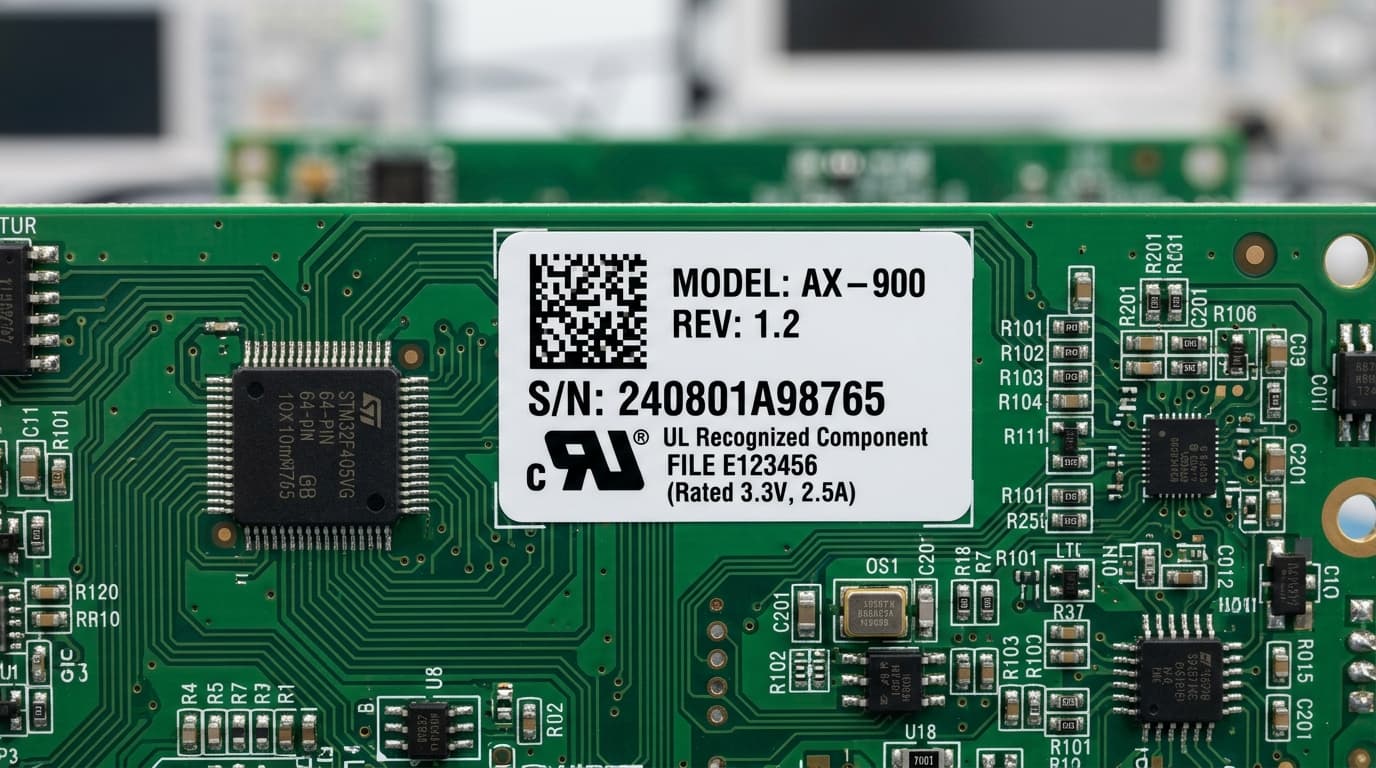
UL 969 Category Codes: PGDQ2 vs. PGJI2
PGDQ2 covers finished printed labels manufactured by a converter and shipped ready-to-apply. PGJI2 covers blank label stock and specific thermal transfer ribbon formulations where the end-user prints variable data (serial numbers, barcodes) in-house. Printing a PGJI2 recognized label with an unapproved ribbon automatically voids UL certification.
UL 969 / CSA C22.2 Pre-Audit Inspector Verification Checklist
Review these 5 critical inspection points before the Authority Having Jurisdiction (AHJ) or field auditor inspects the installation:
UL File MH17154 Recognition Verification
Verify label substrate and ribbon combination is listed in Brady's official UL Directory File MH17154 / MH64936 for the specific substrate type (e.g. powder-coated steel, molded polypropylene, or FR-4 epoxy).
Continuous Operating Temperature Rating
Ensure the label material's UL recognized temperature rating meets or exceeds the maximum operating temperature of the host equipment (e.g. B-423 rated -40°C to 120°C, B-724 rated to 300°C).
Mandated Thermal Transfer Ribbon Pairing
Confirm that labels printed in-house use the exact UL-recognized ribbon series (e.g. R6000HF halogen-free pure resin ribbon on B-423/B-483A polyester).
Substrate Surface Energy Rating (LSE vs HSE)
Inspect adhesion against low-surface-energy surfaces (<30 dynes/cm). Standard acrylic adhesives fail UL 969 72-hour dwell tests on powder coat unless formulated as high-tack rubber/acrylic (B-483A).
Outdoor Weatherability & Environmental Exposure
For outdoor equipment, verify the material passes UL 969 exposure tests (UV light, water immersion, humidity chamber, and sulfur dioxide exposure per ASTM G155).
UL 969 / CSA C22.2 Certified Material Substrate Adhesion Matrix (ASTM D1000)
| Material Code | Stainless Steel (HSE) | Textured Powder Coat (28 dynes) | Cast Aluminum | Polypropylene (LSE) | Engineering Verdict |
|---|---|---|---|---|---|
| Brady B-423 | 45 oz/in | 32 oz/in | 40 oz/in | 25 oz/in | UL recognized permanent rating plate for smooth metals |
| Brady B-483A | 130 oz/in | 115 oz/in | 120 oz/in | 95 oz/in | UL recognized for powder-coated steel & LSE plastics |
| Brady B-428 | 65 oz/in | 48 oz/in | 60 oz/in | 30 oz/in | Metallized matte silver rating plate for equipment chassis |
| Brady B-724 | 40 oz/in | N/A | 38 oz/in | N/A | Polyimide PCB label surviving 300°C wave solder |
Key UL 969 / CSA C22.2 Regulatory Clauses & Mandatory Specifications
| Clause / Section | Regulatory Requirement | Technical Compliance Mandate | Certified B-Numbers |
|---|---|---|---|
| Section 4.1 | Substrate Adhesion & Dwell Time | Labels must achieve permanent bond strength across specified substrates after 72-hour room temperature dwell. | |
| Section 5.2 | Thermal Aging & Cold Exposure | Subject to continuous cyclic thermal shock (-40°C to +150°C) without curling, bubbling, or edge-lifting. | |
| Section 6.3 | Solvent & Fluid Wipe Durability | Withstand mechanical rubbing with mineral spirits, water, and cleaning defluxers without legibility loss. | |
| Section 7.1 | PGJI2 In-House Thermal Ribbon Certification | End-user thermal transfer printing requires certified material-and-ribbon formulation pairing under File MH17154. |
Certified Brady Materials & Mandated Ribbon Formulations
Brady Series R6000HF Pure Resin Ribbon
Brady Series R4300 Wax/Resin Ribbon
Brady Series R6000HF Pure Resin Ribbon
Brady Series R6000HF Pure Resin Ribbon
Orderable Commercial SKUs & Distributor Part Numbers
Build & Size Your UL 969 / CSA C22.2 Conductor Schedule
Import AutoCAD Electrical wire from/to reports, apply 10% scrap safety factors, and calculate exact roll quantities with 1 click.
UL 969 / CSA C22.2 Frequently Asked Compliance Questions
What is the difference between UL 969 PGDQ2 and PGJI2 recognition?
PGDQ2 applies to pre-printed finished labels manufactured by an authorized converter. PGJI2 applies to blank label stocks and specific thermal transfer ribbon formulations where the customer prints variable data (serial numbers, ratings) in-house. Printing on a PGJI2 label with an uncertified ribbon voids UL compliance.
How do I verify if a Brady material is UL 969 recognized?
Look up Brady Worldwide under UL Product iQ Directory File MH17154 (Marking & Labeling Systems) or File MH64936. The record specifies the approved substrate types, maximum continuous temperature ratings, and mandatory ribbon series (such as R6000HF).
Why do standard UL 969 labels peel on powder-coated electrical cabinets?
Polyester powder coats have very low surface energy (≤28 dynes/cm). Standard permanent acrylic adhesives fail to wet out into the microscopic surface texture. You must specify a specialized high-tack rubber/acrylic adhesive system like Brady B-483A (130 oz/in peel strength).
Is UL 969 certification required for CSA approval in Canada?
Yes. Under the UL/CSA mutual recognition agreement, labels tested and certified to UL 969 and CSA C22.2 No. 0.15 (PGDQ8 / PGJI8) receive dual cUL/CSA acceptance for both US and Canadian industrial markets.