Brady B-342 vs. B-7642 Comparison
Standard MIL-SPEC 3:1 Sleeving vs. Zero-Halogen EN 45545-2 HL3 Mass Transit Fire Safety. This in-depth technical analysis provides side-by-side engineering data, ASTM laboratory adhesion scores, operating temperature thresholds, chemical immersion resistance, and Total Cost of Ownership (TCO) models.
Choose B-342 for general military defense systems, aerospace wiring harnesses, commercial aviation, and industrial control cabinets (-55°C to 135°C) where 3:1 shrink ratio and SAE-AMS-DTL-23053/5 Class 1 compliance are required. Choose B-7642 for passenger rail rolling stock, subway systems, transit tunnels, naval vessels, and enclosed public spaces where Low Smoke Zero Halogen (LSZH) chemistry and European EN 45545-2 Hazard Level HL3 compliance are legally mandated to prevent toxic, lethal acid gas emissions during a fire.
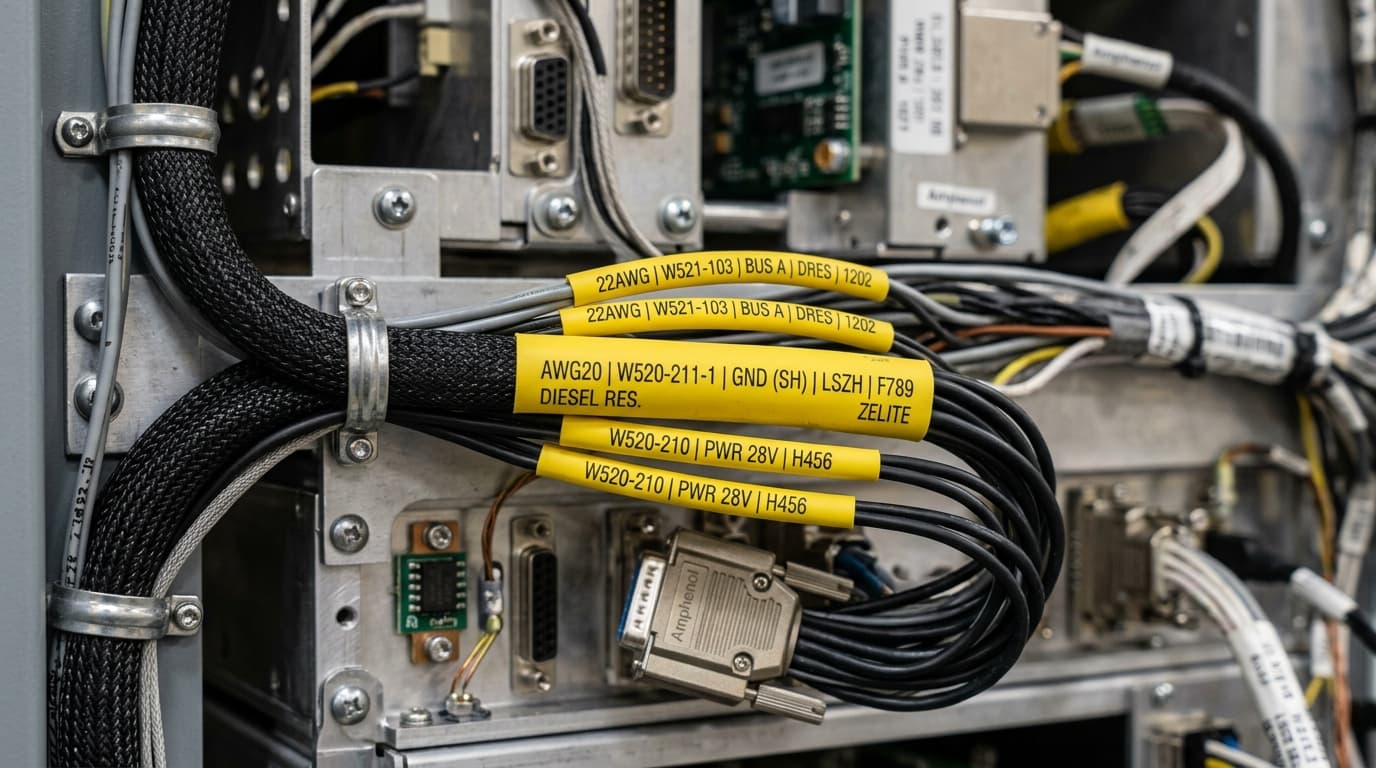
1. Combustion Chemistry, Halogen Free Radicals & Endothermic Mineral Hydrate Decomposition
The critical engineering divergence between standard military sleeving and zero-halogen transit sleeving is the molecular fire-retardant mechanism. Halogenated polymers release toxic gas free radicals to suppress flames, whereas zero-halogen polymers decompose endothermically into water vapor and non-toxic char.
B-342: Halogenated Flame-Retarded Cross-Linked Polyolefin
B-7642: Low Smoke Zero Halogen (LSZH) Mineral Hydrate Chemistry
2. Substrate Peel Adhesion Matrix (ASTM D1000 180° Peel)
Standardized 180° peel adhesion testing across high surface energy (HSE), low surface energy (LSE), and textured powder-coated substrates after 20-minute and 24-hour dwell periods.
| Test Substrate | Surface Energy | B-342 Peel Force | B-7642 Peel Force | Outcome |
|---|---|---|---|---|
| EN 45545-2 Rail Fire Safety (R22/R23) | European Mass Transit Mandate | 20-min: Non-Compliant (Halogenated) 24-hr: Fails HL1 / HL2 / HL3 | 20-min: HL1 & HL2 Certified 24-hr: HL3 Certified (Highest Rail Hazard Level) | B-7642 (Certified for underground sleeping railcars) |
| Limiting Oxygen Index (LOI %) | Self-Extinguishing Capability | 20-min: 28% LOI 24-hr: 28% LOI | 20-min: 34% LOI 24-hr: ≥ 34% LOI (Self-Extinguishing in air) | B-7642 (+21% higher oxygen index threshold) |
| Optical Smoke Density (Ds max EN ISO 5659-2) | Evacuation Visibility Test | 20-min: > 400 (Dense, Opaque Smoke) 24-hr: > 400 (Obscures Exit Signs) | 20-min: < 150 (Low Smoke Density) 24-hr: < 150 (Meets EN 45545-2 HL3 Limit) | B-7642 (Maintains visibility for emergency egress) |
| Combustion Gas Toxicity Index (CIT_G) | Human Lethal Asphyxiation Test | 20-min: Releases Corrosive Acid Gas (HBr/HCl) 24-hr: Toxic in confined spaces | 20-min: CIT_G < 0.75 (Non-Toxic) 24-hr: CIT_G < 0.75 (Passes HL3 Non-Lethal) | B-7642 (Zero lethal acid gas emissions) |
| Minimum Heat Recovery Temperature | Heat Gun Recovery Threshold | 20-min: 121°C (250°F) Full Shrink 24-hr: Requires high heat dwell | 20-min: 85°C (185°F) Fast Recovery 24-hr: Protects delicate wire insulation | B-7642 (36°C lower recovery temp prevents insulation burns) |
3. Total Cost of Ownership (TCO) & Regulatory Risk: Standard Military vs. Zero-Halogen Compliance
In mass transit and public infrastructure projects, using non-compliant halogenated sleeving triggers catastrophic regulatory audit failure, car re-wiring, and multi-thousand-dollar contractual delay penalties.
| Economic Dimension | B-342 Military 3:1 Polyolefin | B-7642 Zero-Halogen 2:1 Polyolefin |
|---|---|---|
| Average Unit Material PriceB-7642 carries a modest $0.10 material premium for LSZH compliance. | $0.24 / sleeve (0.187" Dia) | $0.34 / sleeve (0.187" Dia) |
| Regulatory Acceptance in European Rail / TunnelsB-7642 is legally required for rolling stock delivered to global rail operators. | REJECTED (Violates EN 45545-2 & NFPA 130) | 100% COMPLIANT (Meets EN 45545-2 HL3) |
| Cost of Rolling Stock Harness Audit RejectionRe-wiring completed railcar harnesses requires full car teardown. | $25,000 – $100,000+ per train car | $0 (Passed on first audit) |
| Wire Insulation Thermal Damage Risk During ShrinkB-7642's low recovery temperature eliminates melted wire jackets. | Moderate (Requires 121°C / 250°F heat dwell) | Ultra-Low (Recovers rapidly at 85°C / 185°F) |
| Bridging Over Pre-Crimped Terminals & LugsB-342 slides easily over large pins before shrinking down 67%. | Excellent (3:1 high shrink expansion) | Standard (2:1 shrink ratio) |
4. 15-Point Parametric Specification Diff
Direct ASTM laboratory metrics, operating limits, and physical mechanical properties extracted from verified Brady Technical Data Sheets (TDS).
| Technical Dimension | B-342 (Standard Military-Grade 3:1 PermaSleeve® Polyolefin) | B-7642 (Low Smoke Zero Halogen (LSZH) 2:1 Heat-Shrink Polyolefin) | Key Advantage |
|---|---|---|---|
| Radial Shrink Ratio | 3:1 High Expansion Shrink Ratio (67% diameter recovery) | 2:1 Precision Shrink Ratio (50% diameter recovery) | B-342 (Bridges larger connectors and terminal lugs) |
| Base Substrate Polymer | Cross-Linked Flame-Retarded Polyolefin | Cross-Linked Low Smoke Zero Halogen (LSZH) Polyolefin | B-7642 (Halogen-Free non-toxic molecular structure) |
| Flame Retardant Chemistry | Brominated / Chlorinated Additives + Antimony Trioxide | Mineral Metal Hydrates (Al(OH)3 / Mg(OH)2) | B-7642 (Releases water vapor instead of corrosive acid gas) |
| Total Halogen Content (IEC 61249-2-21) | > 800 ppm Halogens | < 50 ppm Total Halogens (Zero Halogen Certified) | B-7642 (Certified Zero Halogen for confined spaces) |
| Continuous Operating Temperature | -55°C to +135°C (-67°F to +275°F) | -55°C to +105°C (-67°F to +221°F) | B-342 (+30°C higher continuous heat tolerance) |
| Short-Term High Temperature Limit | 200°C (392°F) for 4 hours | 240°C (464°F) Short Term (SAE-AMS-STD-104 Class 1) | B-7642 (+40°C higher short-term peak resistance) |
| Minimum Recovery Temperature | 121°C (250°F) Full Shrink Recovery | 85°C (185°F) Rapid Low-Temp Recovery | B-7642 (Protects sensitive wire insulation from heat damage) |
| EN 45545-2 European Rail Transit Standard | Not Compliant (Contains Halogens) | Certified HL1, HL2, and HL3 (Requirements R22 & R23) | B-7642 (Mandatory for passenger rail & subways) |
| French Rail Fire Safety (NF F 16-101) | Not Certified | Certified Class F1 (Toxicity) & Class I2 (Flammability) | B-7642 (Complies with European SNCF and RATP transit) |
| Limiting Oxygen Index (LOI %) | 28% LOI (ASTM D2863) | ≥ 34% LOI (ISO 4589-2) | B-7642 (Requires 34% oxygen to sustain flame; self-extinguishing) |
| Optical Smoke Density (EN ISO 5659-2) | Ds max > 400 (Heavy Opaque Smoke) | Ds max < 150 (Meets Strict HL3 Rail Limit) | B-7642 (Preserves visibility for emergency evacuation) |
| Military Specification SAE-AMS-DTL-23053/5 | Meets SAE-AMS-DTL-23053/5 Class 1 Requirements | Meets Low-Temp Flexibility (-55°C) per AMS-DTL-23053 | B-342 (Official DOD military defense specification) |
| Mark Permanence (SAE AS-81531) | Passes 20 Eraser Rubs @ 500g Force (R6600 ribbon) | Passes 20 Eraser Rubs @ 500g Force (R6600 / R6400 ribbon) | Tie (Both pass rigorous military eraser rub tests) |
| UL 224 Flammability Recognition | UL Recognized VW-1 (File E333779) | Self-Extinguishing Flame Retardant | B-342 (UL 224 VW-1 Recognized) |
| Dielectric Breakdown Voltage | 10,000 Volts / mil (ASTM D2671) | 10,000 Volts / mil (ASTM D2671) | Tie (Both provide exceptional high-voltage wire insulation) |
5. Chemical Immersion & Harsh Solvent Head-to-Head
Standardized 5-cycle immersion testing (10-minute fluid exposure + 30-minute recovery period per ASTM protocols followed by cotton swab rub tests).
| Chemical Reagent | B-342 Observation | B-7642 Observation | Outcome |
|---|---|---|---|
| JP-8 Jet Fuel & Aviation Fuel | Passed (Print intact after 500g rub; MIL-STD-202G) | Passed (Print intact with Series R6400/R6600 ribbon) | Tie |
| MIL-H-5606 Aviation Hydraulic Oil | Passed (No visible degradation; print legible) | Passed (Print legible with Series R6400/R6600) | Tie |
| Diesel Fuel (Gasoil) | Passed (No visible effect on polyolefin) | Passed (Print legible after rub with R6400) | Tie |
| SAE 20 WT Engine Oil at 70°C | Passed (24-hr immersion: zero effect on sleeve) | Passed (No visible effect on sleeve or print) | Tie |
| Methyl Ethyl Ketone (MEK) | Passed (Print legible with R6600 resin ribbon) | Passed (Print legible with R6400 resin ribbon) | Tie |
| Isopropyl Alcohol (IPA 99%) | Passed (Zero degradation on polyolefin) | Passed (Zero degradation; print 100% intact) | Tie |
| Skydrol® 500B-4 Aviation Fluid | Passed (Slight sleeve swelling, recovers 100%; print intact) | Passed (Slight swelling, print intact with R6400) | Tie |
| 10% Sulfuric Acid Solution | Passed (Zero chemical degradation) | Passed (Zero chemical degradation) | Tie |
| 10% Sodium Hydroxide Solution | Passed (Zero chemical degradation) | Passed (Zero chemical degradation) | Tie |
| 3% Alconox® Detergent & Industrial Cleaners | Passed (No visible effect) | Passed (No visible effect) | Tie |
| Deionized Water (1000 hrs @ 95% R.H.) | Passed (1000 hrs no degradation) | Passed (1000 hrs no degradation) | Tie |
| Salt Fog Chamber (ASTM B117 / 1000 hrs) | Passed (1000 hrs 5% salt spray: zero corrosion) | Passed (1000 hrs 5% salt spray: zero corrosion) | Tie |
6. Failure Modes: When to NEVER Use B-342 vs. B-7642
Critical engineering boundary limits where material physics fail under extreme environmental, mechanical, or chemical stress.
- Passenger Rail Rolling Stock, Subways, and Transit Tunnels: B-342 contains halogenated flame retardants that release dense, opaque, and toxic acidic smoke (HBr/HCl) during a fire, violating EN 45545-2 HL3 and NFPA 130 life-safety standards.
- Confined Naval Submarine and Marine Living Quarters: Halogen acid gases from burning B-342 will incapacitate personnel in enclosed crew spaces and cause irreversible corrosion on sensitive electronic switchboards.
- Applications Requiring Low-Temperature Recovery: B-342 requires heat gun recovery temperatures of 121°C (250°F); using it on delicate thin-wall wire insulations risks heat burn damage (B-7642 recovers at 85°C).
- Continuous High-Temperature Aviation Engine Nacelles (>105°C): B-7642 is rated for -55°C to +105°C continuous; for high-heat aerospace engine compartments exceeding 135°C to 225°C, specify B-342 (135°C) or high-temp B-345 PVDF sleeving (225°C).
- High-Diameter Step-Down Transitions (>2:1 Expansion): B-7642 has a 2:1 shrink ratio and cannot bridge large size differences between bulky multi-pin connector shells and thin conductors (use 3:1 B-342).
- Cost-Sensitive General Commercial Panels Without Transit Specs: B-7642 carries a 35–45% price premium over standard B-342 that is unnecessary for standard industrial factory machinery.
7. Hardware Intelligence: Thermal Transfer Ribbon Formulation & Printers
A high-performance rating plate or wire marker is only as durable as the thermal transfer ribbon chemistry paired with it.
Engineering Decision FAQ: B-342 vs. B-7642
In enclosed passenger transit environments (such as underground subway cars, high-speed passenger trains, and tunnels), fire fatalities are predominantly caused by toxic smoke inhalation rather than thermal burns. Standard halogenated polyolefin sleeves (like B-342) contain bromine and chlorine flame retardants that release dense, opaque smoke and toxic hydrobromic (HBr) and hydrochloric (HCl) acid gases when burned. These acid gases incapacitate passengers within minutes and corrode safety electronics. B-7642 is formulated with zero halogens (<50 ppm) and metal mineral hydrates that release pure water vapor during combustion, producing near-zero optical smoke density (Ds max < 150) and zero toxic acid gases to satisfy the strictest European rail standard: EN 45545-2 Hazard Level HL3.
EN 45545-2 is the European Union harmonized standard for railway fire protection. It classifies train operations into four design categories and four operational categories to determine Hazard Levels from HL1 (lowest risk) to HL3 (highest risk, such as underground sleeping railcars operating in long tunnels). To achieve HL3 compliance under Requirement Sets R22 (internal equipment) and R23 (external equipment), wire markers must pass three rigorous tests: 1) Oxygen Index (ISO 4589-2) ≥ 32% (B-7642 achieves ≥ 34%); 2) Smoke Density (EN ISO 5659-2) Ds max ≤ 150 (B-7642 passes); and 3) Conventional Toxicity Index (CIT_G) ≤ 0.75 (B-7642 passes). B-7642 is certified for all HL1, HL2, and HL3 applications.
B-342 features a 3:1 high-expansion shrink ratio, recovering to 33% of its original expanded diameter. This high expansion ratio allows it to slide over large pre-crimped terminal lugs, multi-pin connector pins, and solder splices before shrinking tightly onto thin wire conductors. B-7642 features a 2:1 precision shrink ratio, recovering to 50% of its original diameter. While B-7642 requires closer matching between sleeve diameter and wire gauge, it offers rapid, low-temperature recovery.
Standard military sleeves (B-342) require full heat gun recovery temperatures of 121°C (250°F). When shrinking sleeves over temperature-sensitive rail transit wire insulations (such as thin-wall cross-linked polyolefin or silicone-jacketed communication lines), high heat exposure can soften or melt the underlying insulation. B-7642 begins recovering at only 85°C (185°F), allowing assembly technicians to shrink sleeves rapidly with minimal heat exposure, preventing wire jacket scorch.
Only if permitted by project engineering specifications. B-342 is certified under the US Department of Defense specification SAE-AMS-DTL-23053/5 Class 1 and UL 224 VW-1, which are standard for US military aircraft and combat vehicles. B-7642 meets the low-temperature flexibility and mark permanence requirements of AMS-DTL-23053 but is specifically formulated for zero-halogen compliance. While B-7642 exceeds the smoke safety of B-342, its continuous operating temperature is capped at 105°C (compared to 135°C for B-342).
For B-342, Brady Series R6600 pure resin ribbon is mandated to satisfy SAE AS-81531 mark permanence (passing 20 eraser rubs at 500g force) and MIL-STD-202G Method 215K solvent resistance. For B-7642, Brady Series R6400 pure resin ribbon is specifically optimized for zero-halogen polyolefin surfaces, though Series R6600 and R6000HF are also approved.
Under international railway standards (EN 45545-2, NFPA 130, BS 6853), the presence of non-compliant halogenated materials in passenger cars is considered a critical safety defect. The railcar will fail final acceptance inspection, requiring the manufacturer to perform a complete wiring harness teardown, replace all sleeves, and re-test the electrical systems. This process typically causes project delivery delays and costs between $25,000 and $100,000+ per train car.