EN 45545-2 Railway Labeling: Why Even the Wire Sleeve Is Fire-Rated
European rail fire safety works backward from one scenario: a fire on a train that cannot immediately stop somewhere survivable. Every material aboard is scored on how much heat, smoke, and toxic gas it contributes to that scenario — down to the marking sleeve on a single wire, multiplied by the thousands of wires in a railcar. Here is how the hazard levels escalate, and what the labeling bill of materials looks like when the contract says EN 45545-2.
1. Hazard Levels: Severity Follows Evacuation Time
The vehicle's operation category (where it runs) and design category (what it is) combine to assign a hazard level; the hazard level then selects how strict the material requirement sets are:
| Level | Assignment Logic | Material Consequence |
|---|---|---|
| HL1 | Vehicles with the most favorable evacuation profile — surface operation, quick egress | Baseline requirement sets |
| HL2 | The broad middle: mainline and suburban stock, mixed infrastructure | The common contractual tier |
| HL3 | Worst-case evacuation: underground sections, long tunnels, sleeping vehicles | Most severe limits on heat release, smoke density, and toxicity |
The tested properties behind those requirement sets are heat release, flame spread, smoke density, and smoke toxicity — which is precisely where halogen chemistry fails and LSZH passes.
2. The Rail Labeling Bill of Materials
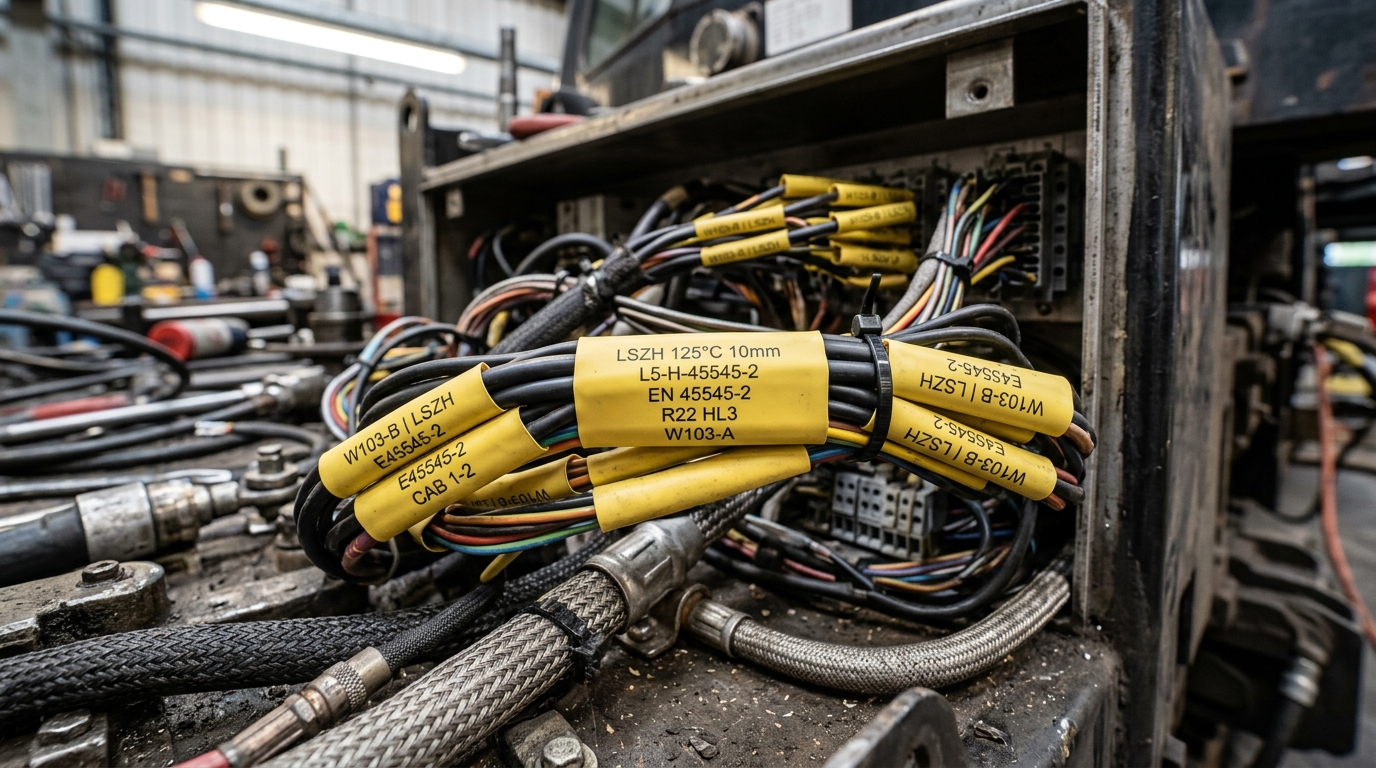
- Wire marking: B-7642 PermaSleeve LSZH — 2:1 zero-halogen polyolefin, UL 224 file E146526, 949 SKUs. The 2:1 window trade-off vs. standard 3:1 sleeves is covered in the shrink ratio guide.
- Component & equipment ID: Halogen-free ribbon pairings — the R6000 Halogen Free series appears throughout the TDS ribbon tables for rated stocks, for exactly this reason.
- Interior signage: Requirement-set assessed stocks — verify the certificate for the specific stock and hazard level rather than assuming a family-level pass.
Rail primes audit at the SKU level: the assessment documentation for the specific sleeve diameter and color you install, at the hazard level your vehicle carries. Build the submittal package during procurement, not during the audit — and treat "halogen-free" marketing copy as a starting claim to verify, not a compliance answer.
Standard vs. LSZH sleeve, spec by spec
The B-342 vs. B-7642 comparison lays out the full delta — shrink ratio, temperature envelope, fire performance, and cost class.