NFPA 79 Machine Wiring Identification: Colors, Numbers & Nameplates
NFPA 79 is the electrical standard for the machine — everything from the disconnect handle to the last proximity switch. Its identification rules exist for one scenario: a maintenance tech, schematic in hand, tracing a fault at 2 a.m. on a machine built by someone else a decade ago. Color tells them what class of circuit they are touching; the wire number tells them where it goes; the nameplate tells them what feeds it.
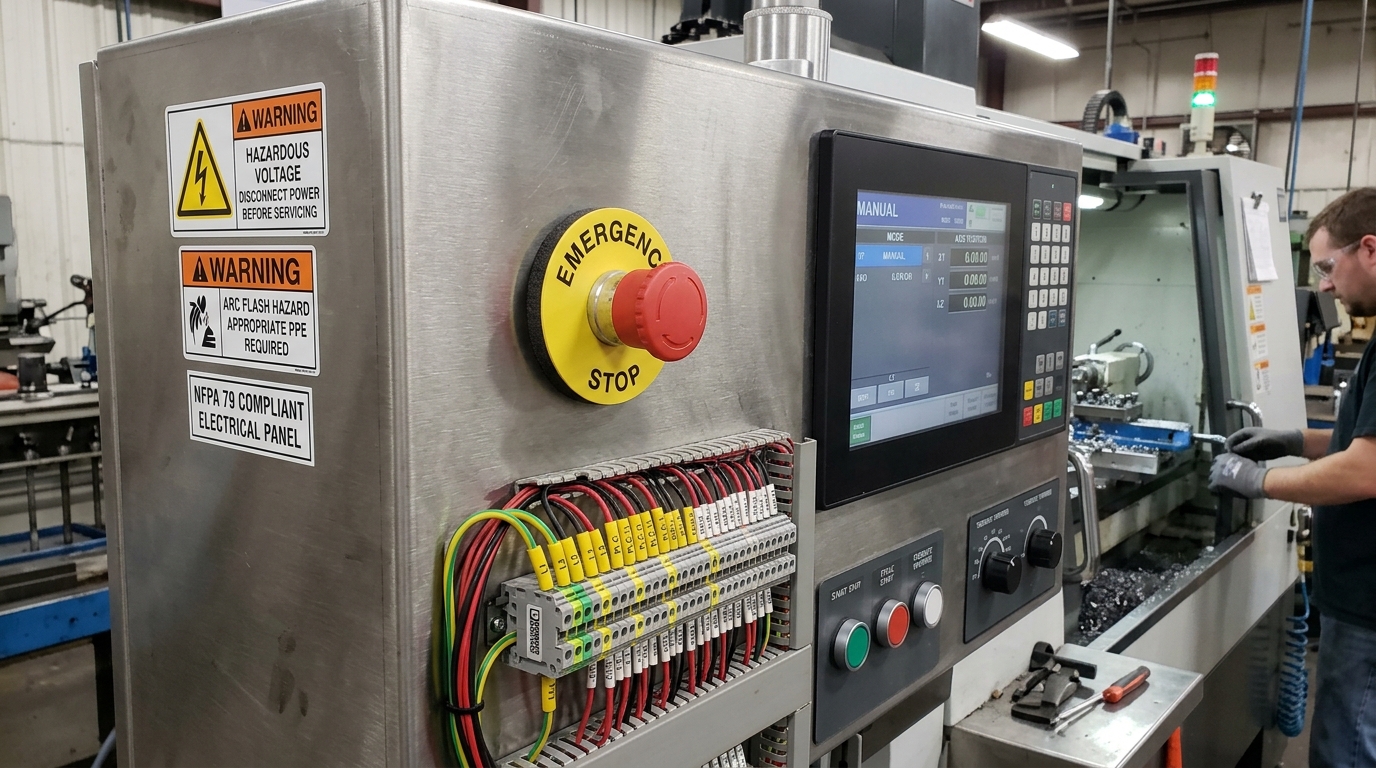
1. The Conductor Color Convention
The customary NFPA 79 scheme, rendered as it appears in the cabinet. Two colors are non-negotiable safety semantics (green/yellow and orange); the rest are circuit-class conventions that make a schematic readable in copper:
Excepted-circuit conductors stay live with the main disconnect open. Beyond the orange insulation, flag the enclosure itself: an ANSI Z535 label at the disconnect — "Warning: orange wiring remains energized" — printed on B-595 vinyl, is the difference between a convention and a communicated hazard. See the Z535 signal word guide for header selection.
2. Wire Numbers: Both Terminations, Matching the Print
Color gives the circuit class; the printed identifier gives the specific conductor. The working rule: every conductor is identified at each termination, with markings that match the machine's electrical documentation — so schematic wire 1042 is physically readable at both the PLC output card and the motor starter coil it lands on.
B-342 PermaSleeve heat-shrink slid on before crimping — no adhesive to creep over the machine's life, -55°C to +135°C service. The self-lam vs. heat-shrink guide covers the full decision.
B-427 self-laminating vinyl wraps applied to landed wires from an M610 handheld at the machine — the clear tail seals the legend against coolant mist and oil film.
Renumbering an undocumented machine? Export the wire list from your CAD package — the AutoCAD Electrical export tool and EPLAN converter turn the schedule into print-ready marker files.
3. Machine-Level Marking Checklist
- Machine electrical nameplate at the supply entry: supply voltage, phase, frequency, full-load current, largest motor, interrupting rating, and electrical diagram number — on UL 969 recognized stock (B-483 / B-593 class), not signage vinyl.
- Disconnect handle identified, plus arc flash warning per NEC 110.16 and the site NFPA 70E study — see the arc flash label guide for the 130.5(H) data label.
- Every enclosure door that hides excepted (orange) wiring carries the energized-circuits warning.
- Operator devices (E-stops, selector switches, pushbuttons) labeled with durable legend plates — B-593 raised panel plates drop into 22mm and 30mm cutouts without engraving lead time.
- Conductor identification verified against the as-built schematic before handoff — a wire number that matches an outdated print is worse than no number.
Full standard breakdown with testing protocols
The NFPA 79 standards hub covers scope, revision history, and the compliant Brady material matrix — alongside UL 508A and NEC 409 for the panel side.